
Addressing NA budget debate, PPP chairman welcomes US-Iran deal, renews call for Britain’s constitutional rights
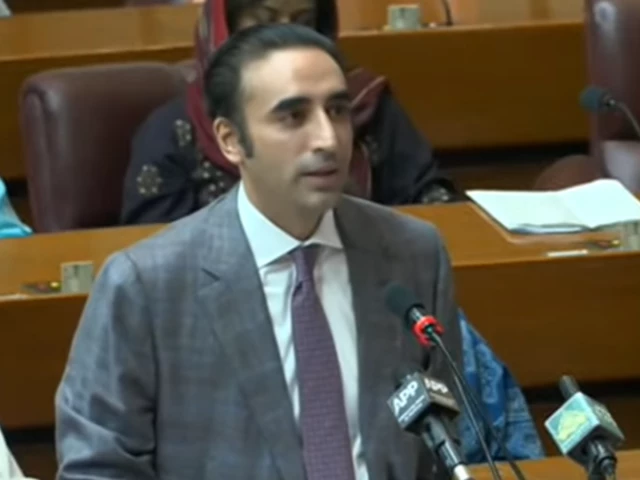
Pakistan People’s Party Chairman Bilawal Bhutto Zardari speaking before the National Assembly. SCREENSHOT
ISLAMABAD:
Pakistan People’s Party (PPP) Chairman Bilawal Bhutto Zardari on Thursday strongly defended the Benazir Income Support Program (BISP), describing it as an economic and national security initiative and calling criticism of the program “regrettable and shameful”.
Speaking during the National Assembly debate on the federal budget for the 2026-2027 financial year, Bilawal said the success of the program had been recognized by international institutions and argued that it should be expanded rather than reduced.
“Targeting the Benazir Income Support Program is regrettable and shameful,” he said. “The work of the Benazir Income Support Program is recognized by international institutions. The world considers it a successful program.”
Welcoming the government’s decision to increase BISP allocations in the upcoming budget, Bilawal said the PPP would continue to champion the program regardless of political opposition.
“BISP is an economic and national security programme,” he said, adding that Pakistan’s economy could achieve sustainable growth only through increased investment in social welfare policies.
He argued that economic progress was inseparable from social justice, saying that Pakistan’s development depended on improving the lives of workers and farmers. “Pakistan’s economy will only progress when workers progress,” he said. “When the farmer grows, Pakistani agriculture grows.”
Bilawal also criticized Pakistan’s dependence on borrowing, pointing out that the country continued to rely on borrowing to finance its budget and repay its existing debt.
The PPP Chairman also welcomed the recent peace agreement between the United States and Iran and congratulated Pakistan’s leaders for their role in promoting regional stability.
He said Pakistan had repeatedly witnessed the economic costs of instability and uncertainty, which was why the country constantly advocated dialogue and peaceful resolution of conflicts.
“We have suffered the economic impact of uncertain situations. That is why Pakistan always promotes peace,” he said, describing peace as both a moral and economic necessity. “When the region is stable, investments increase. When there is peace, young people find jobs and the country progresses.”
Bilawal said that although the international community seems to be moving towards peace, Pakistan must now focus on development and economic growth.
He, however, warned that regional challenges remained, citing security concerns along the Afghan border, India’s threats of “Operation Sindoor 2.0” and New Delhi’s position on the Indus Waters Treaty. “I can proudly say that Pakistan responded to the challenge by demonstrating political unity and democratic tradition,” he said.
Bilawal noted that the federal and provincial governments had agreed to jointly shoulder the burden of increased defense and national security requirements despite the budgetary constraints imposed under the IMF program.
He said provinces had repeatedly sacrificed development spending to support national economic stability and maintain required budget surpluses.
“Punjab recorded a surplus of Rs700 billion last year and Rs900 billion this year,” he said. “Punjab could have spent this money in Multan and Dera Ghazi Khan, but the provinces are not spending these funds to support the national economy.”
Referring to the merged tribal districts, Bilawal said commitments made to erstwhile FATA were yet to be fulfilled.
He also acknowledged the support of the Pakistan Tehreek-e-Insaf-led government in Khyber-Pakhtunkhwa, noting that despite political differences, it had agreed to contribute to national defense needs under the agreement between the federation and the provinces.
Later in his speech, Bilawal thanked the people of Gilgit-Baltistan (GB) for their support, noting that the PPP had secured 11 seats in the region. He described the people of Britain as one of the most patriotic citizens of Pakistan and reiterated his commitment to protecting their political and constitutional rights.
Bilawal said the British people had historically gained freedom from Dogra rule and acceded to Pakistan, but they still faced unresolved constitutional issues. “Those who have liberated themselves from the Dogra regime, how long can they be deprived of their constitutional rights?” he asked.
He called for a serious review of Britain’s long-standing constitutional claims and proposed interim representation for the region in Parliament. The PPP chairman stressed that this issue required national consensus and collective political agreement to ensure a lasting solution.
This story is currently being updated.


