
Nexus funds, arms and trains militants who exploit women and youth for bombings and anti-state acts
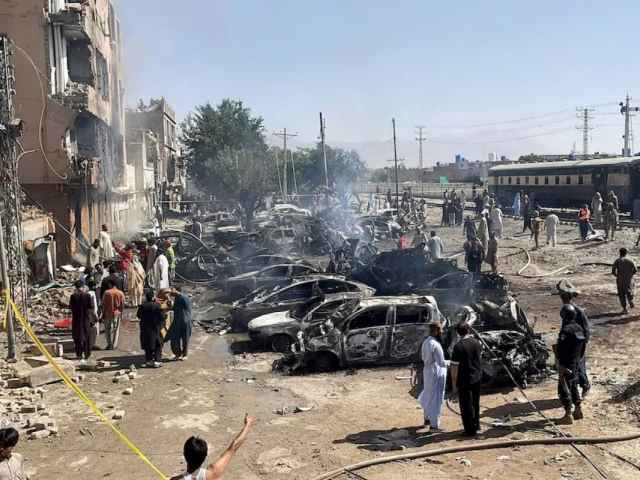
People and police officers gather after an explosion near a railway track in Quetta, Pakistan, May 24, 2026. Photo taken with a cellphone. REUTERS/Stringer
The banned Balochistan Liberation Army (BLA) maintains links with Al-Qaeda and Tehreek-e-Taliban Pakistan (TTP), which continue to fuel terrorism, sabotage and societal destabilization in Balochistan and other parts of Pakistan.
This nexus provides funding, training, weapons and logistical support, allowing the organization to exploit vulnerable women and youth in the region as tools for suicide attacks and other anti-state activities.
Balochistan Chief Minister Mir Sarfraz Bugti and senior security officials have consistently emphasized that the operational capabilities of the BLA are significantly enhanced by this support from Al-Qaeda and the TTP, aimed at disrupting the China-Pakistan Economic Corridor (CPEC) and other national development projects.
Learn more: Bugti commits to supporting victims of train attack
The government has repeatedly emphasized that Al Qaeda and the TTP are the main sponsors of the BLA-TTP nexus, channeling their support through Afghan territories to orchestrate attacks against civilians, infrastructure and security forces.
Afghanistan remains a key sanctuary for BLA operatives, where training and planning takes place prior to cross-border infiltration into Pakistan. This cross-border infrastructure allows the movement of facilitators, recruits and suicide bombers.
The foreign-orchestrated network relies largely on the systematic exploitation of Baloch women and girls. Security operations have repeatedly intercepted cases in which vulnerable women were radicalized, trained and deployed for suicide attacks.
In one such case, in Khuzdar, security forces arrested Laiba (also known as Farzana), a would-be suicide bomber who had been indoctrinated through a chain involving BLA-linked commanders and individuals such as Dr. Sabiha, who target financially vulnerable girls through psychological manipulation and coercion. Laiba had been tasked with recruiting other young women for similar missions.
In another case, Raheema Bibi’s confession revealed how her husband facilitated the attack on a female suicide bomber linked to the Balochistan Liberation Front (BLF), Zarina Rafiq. The woman stayed at their residence before being sent to Afghanistan for training and later carried out an attack on a Frontier Corps camp.
Learn more: 16 killed, 23 injured in Balochistan two days after Eid
Sindh authorities also foiled a plot involving a minor Baloch girl who was groomed via social media by BLA operatives for a suicide attack in Karachi. The girl then publicly warned that such practices violated Baloch cultural traditions that uphold the dignity and protection of women.
A structured pattern was identified marking ideological radicalization through certain militant platforms, followed by BLA recruitment, training in Afghanistan and operational deployment. When plans are disrupted, associated networks often turn to “missing persons” stories to obscure activist connections.
In collaboration with elements of the TTP and al-Qaeda, the BLA carried out numerous attacks against security personnel, Chinese workers, schools, and economic infrastructure.
Security forces conduct intelligence-led operations, supported by local communities, with a zero-tolerance policy towards terrorism as well as rehabilitation and de-radicalization programs for misled individuals, particularly women and youth.
The government has repeatedly urged parents to monitor online activity, as social media is a primary vector of radicalization, not to mention officials calling for international action against states using proxies to destabilize Pakistan.


