
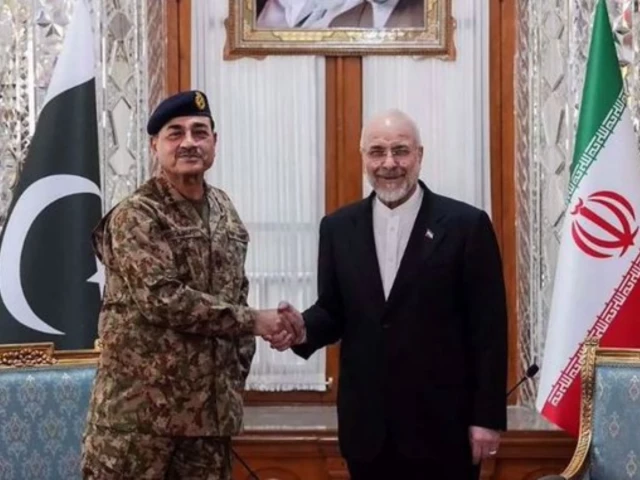
Marshal arrived in Iran as part of ongoing peace negotiation efforts with the United States
CDF Munir meets Iranian President Ghalibaf in Tehran. PHOTO:
Chief of Defense Forces (CDF) and Chief of Army Staff Field Marshal Asim Munir met Iranian Parliament Speaker Mohammad Bagher Ghalibaf in Tehran on Thursday. PressTV reported on X.
CDF Munir arrived in Tehran on Wednesday as part of the ongoing peace negotiation efforts in the Middle East. He was part of a delegation that also included Interior Minister Mohsin Naqvi. Iranian Foreign Minister Abbas Araghchi received the delegation, Inter Services Public Relations ISPR said in a statement.
چیف آف ڈیفنس اسٹاف فیلڈ مارشل سید عاصم منیر تہران پہنچ گئے۔ وزیر داخلہ محسن نقوی بھی آرمی چیف کے ہمراہ۔ دورہ تہران ثالثی کی پاکستانی کوششوں کا حصہ ہے۔ pic.twitter.com/drQnysbgd8
– PTV News (@PTVNewsOfficial) April 15, 2026
Araghchi said he was “delighted” to welcome the marshal during his visit. “Expressed gratitude for Pakistan’s gracious hosting of the dialogue, emphasizing that it reflects our deep and great bilateral relationship. Our commitment to promoting peace and stability in the region remains strong – and shared.”
I am delighted to welcome Marshal Munir to Iran.
Expressed gratitude for Pakistan’s gracious hosting of the dialogue, stressing that it reflects our deep and great bilateral relationship. Our commitment to promoting peace and stability in the region remains strong and shared. pic.twitter.com/e74lm6hL8r
– Seyed Abbas Araghchi (@araghchi) April 15, 2026
The delegation then held a meeting with FM Araghchi and other Iranian officials.
Iran had earlier said it continued to exchange messages with Washington through Pakistani mediators.
“The exchange of messages continues” regarding negotiations with the United States, Foreign Ministry spokesperson Esmaeil Baghaei said at a press briefing cited by the official news agency. IRNA.
“Since Sunday, when the Iranian delegation returned to Tehran, multiple messages have been exchanged through Pakistani intermediaries,” he said, adding: “Our positions have been transmitted and heard.”
On the nuclear issue, the spokesperson declared that discussions on uranium enrichment are not new. “There is room for discussion about the type and level of enrichment,” he said. “The Islamic Republic of Iran must be able to continue its enrichment according to its national needs,” he added.
Esmaeil Baghaei, FM spokesperson: Exchange of messages between #Iran and the United States continues via Pakistan’s mediation. Iran’s positions are clear and consistently expressed. Tehran should soon welcome a Pakistani delegation. #Diplomacy@IRIMFA_SPOX
— Government of the Islamic Republic of Iran (@Iran_GOV) April 15, 2026
The United States and Iran held rare direct talks in Pakistan last weekend aimed at ending their conflict, but the talks ended early Sunday without any agreement.
On April 11, the American and Iranian delegations arrived in Pakistan for conclusive negotiations after an immediate two-week ceasefire “everywhere, including Lebanon”, announced by Prime Minister Shehbaz, who then invited the two countries’ delegations to Islamabad.
Learn more: No date has been set for the second round of US-Iran negotiations (FO)
The two sides failed to reach an agreement to end their war despite marathon negotiations that lasted around 21 hours in Islamabad over the weekend. The protracted talks, aimed at ending hostilities that have left thousands dead and sent global oil prices soaring over the past six weeks, have resulted in both sides blaming each other for the impasse.
The United States and Israel launched a joint offensive against Iran on February 28, killing thousands of people in Iran, including then-supreme leader Ayatollah Ali Khamenei, and injuring tens of thousands, including civilian areas, including residential buildings and religious sites.
The conflict has also expanded geographically. Iran responded with drone and missile strikes targeting Israel as well as Jordan, Iraq and Gulf countries hosting US military assets. It also restricted the movement of ships through the Strait of Hormuz.


