
Pakistan, China seek to deepen trade, technology and strategic cooperation on 75th anniversary of relations
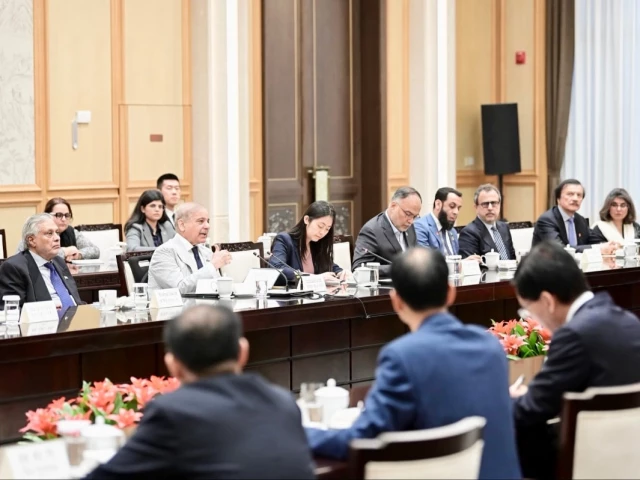
Prime Minister Muhammad Shehbaz Sharif and the Pakistani delegation met with HE Wang Hao and his delegation, Party Secretary of Zhejiang Province, in Hangzhou on Saturday, May 23. PHOTO: Ishaq Dar
Prime Minister Shehbaz Sharif arrived in Hangzhou, Zhejiang province, on Saturday for what China’s Foreign Ministry described as an “important high-level exchange” between the two countries to mark the 75th anniversary of the establishment of diplomatic ties.
I arrived in the beautiful and vibrant city of Hangzhou, Zhejiang province, as part of my official visit to China.
I am deeply grateful to the leaders of Zhejiang Province for the warm welcome extended to me and my delegation.
We look forward to strengthening practices… pic.twitter.com/T60RoRsDrh
– Shehbaz Sharif (@CMShehbaz) May 23, 2026
“China hopes that the two sides will take this visit as an opportunity to continue traditional friendship, deepen cooperation in all fields and write a new chapter in building an even closer China-Pakistan community and shared destiny in the new era,” a Foreign Ministry spokesperson said.
The visit, which will take place from May 23 to 26, is expected to open a new chapter in the 75-year-old China-Pakistan relations, long recognized for their mutual trust and enduring cooperation despite changing international circumstances, according to a commentary published on the Chinese newspaper. CGTN website.
At a ceremony held in Islamabad on Thursday, Prime Minister Shehbaz hailed the “unshakable” friendship between Pakistan and China, saying China had always supported Pakistan in both prosperity and difficulties. “Earthquakes, floods, peace and difficult times: China has always steadfastly supported Pakistan,” he said.
Delighted to be in beautiful Hangzhou, China with Prime Minister Shehbaz Sharif @CMShehbaz and members of the Pakistani delegation.
Expect several engagements including executive meetings and attendance at the Pakistan-China B2B Investment Conference in Hangzhou tomorrow… pic.twitter.com/wh6nowxxBH
-Ishaq Dar (@MIshaqDar50) May 23, 2026
Over the past 75 years, Pakistan and China have enjoyed an ever-expanding relationship. In 2015, the two countries upgraded their relations to an ironclad strategic cooperative partnership and subsequently agreed to build a closer China-Pakistan community with a shared future in the new era.
Qian Feng, director of the research department at the Institute of National Strategy at Tsinghua University, said the visit reflected Pakistan’s desire to attract more Chinese private companies and inject new impetus into bilateral economic cooperation.
Learn more: PM Shehbaz arrives in Hangzhou for four-day official visit to China
Economic cooperation under the China-Pakistan Economic Corridor (CPEC), launched in 2013, remains the cornerstone of bilateral relations. Chinese Ambassador to Pakistan Jiang Zaidong in a recent article described CPEC as a flagship project of the Belt and Road Initiative, saying it had attracted more than $25.9 billion in direct investment and created more than 260,000 jobs in Pakistan.
Prime Minister Muhammad Shehbaz Sharif met with Wang Hao, Party Secretary of the Zhejiang Provincial Committee of the CPC in Hangzhou on Saturday and discussed issues related to bilateral cooperation. PHOTO: APPLICATION
According to Chinese officials, CPEC projects have added more than 8,000 MW to Pakistan’s power capacity, developed 510 km of roads and 886 km of transmission lines, while the Gwadar port has been expanded to become a major regional hub capable of handling large cargo ships. The Suki Kinari hydropower project in Khyber-Pakhtunkhwa also generates 884 MW of clean energy, reducing dependence on coal and carbon emissions.
Pakistan Minister for Planning, Development and Special Initiatives Ahsan Iqbal said CPEC has significantly strengthened Pakistan’s energy security, infrastructure and regional connectivity while laying the foundation for a modern economic framework.
At the seventh round of China-Pakistan Foreign Ministers’ Strategic Dialogue in January, the two countries agreed to further align their development priorities and accelerate work on an upgraded version of the corridor, commonly known as CPEC 2.0.
Read also: Pakistan-China friendship ‘tested and unbreakable’, says PM Shehbaz on 75th anniversary of diplomatic ties
“CPEC is now entering its second phase, marking a strategic shift from infrastructure development towards industrialization, innovation and inclusive growth,” Iqbal said, adding that both sides hoped to transform the project into a corridor of “hope, innovation, opportunity and prosperity”.
Pakistan-China and Afghanistan affairs expert Rashid Safi termed Prime Minister Shehbaz’s visit as strategically important for regional stability, economic cooperation and strengthening bilateral relations.
He said the visit came at a critical time as the two countries celebrated 75 years of diplomatic relations amid changing geopolitical dynamics, economic challenges and regional security concerns. “In this context, the visit is seen as a major effort to give a new direction to the future partnership between the two brotherly countries,” he said. APPLICATION.
According to Safi, the visit goes beyond formal diplomacy and aims to achieve progress in the areas of economic cooperation, investments, technology, media, information technology, industrial collaboration, agriculture and regional connectivity.
He said the prime minister’s first stop in Hangzhou was particularly significant as the city is considered one of China’s leading centers for cutting-edge technology, e-commerce, artificial intelligence and the digital economy.
Safi added that the Prime Minister’s expected visit to Alibaba Group headquarters would assume particular significance as Pakistan seeks to accelerate digitalization, e-commerce expansion and IT exports. He added that under CPEC 2.0, both countries were now giving special importance to industrial zones, exports, youth employment, agricultural reforms, technology transfer and regional trade connectivity.
“Pakistan seeks to accelerate economic growth through the relocation of Chinese industries, manufacturing and investments, while China views Pakistan as an important trade, logistics and economic hub in the region,” he said.
Regional and global developments are also expected to feature prominently during the visit, particularly tensions between the United States and Iran, the situation in the Middle East, developments in the Arabian Sea, energy supply routes, Afghanistan and broader regional stability.
Prime Minister Muhammad Shehbaz Sharif @CMShehbaz and the Pakistani delegation met HE Wang Hao and his delegation, Party Secretary of Zhejiang Province, in Hangzhou this evening.
The Prime Minister highlighted the vitality of all-weather strategic cooperation between Pakistan and China… pic.twitter.com/oNtc6LSMYK
-Ishaq Dar (@MIshaqDar50) May 23, 2026
Safi said Pakistan and China favored dialogue, diplomacy and economic cooperation over conflict, arguing that connectivity and trust-building remained key to regional prosperity. He also praised China’s governance and public security systems, saying many Chinese cities have become examples of discipline, safety and public trust.
“In various Chinese cities, local residents and foreign tourists enjoy an extremely secure environment,” he said, adding that public activity until late at night and the safe movement of women, families and foreigners reflected the success of China’s governance model.
According to Safi, the long-standing friendship between Pakistan and China goes beyond diplomacy, with the two countries constantly supporting each other during difficult times.
“This is why Pakistan-China relations are globally recognized as an ironclad strategic cooperative partnership,” he said, adding that the celebrations marking 75 years of diplomatic relations reflected the two countries’ commitment to shared development, regional stability, economic cooperation and a more connected Asia.
(With additional input from agencies)


