
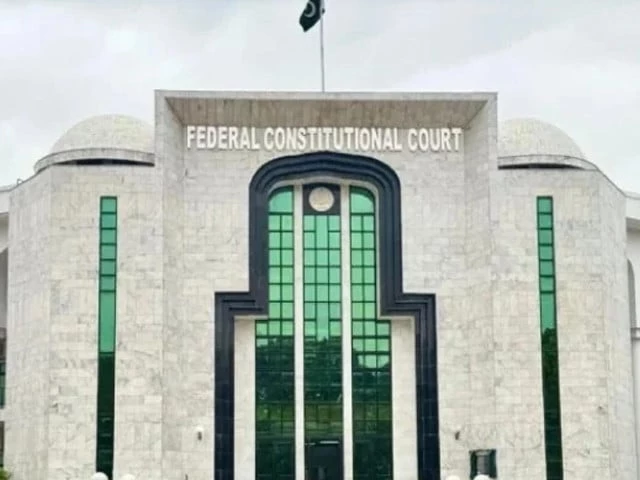
The Court observes that an interim configuration can never be assimilated in terms of authority to an elected government
ISLAMABAD:
The Federal Constitutional Court (FCC) declared appointments made during the transition period illegal, while upholding the constitutionality of a law passed to fire these employees, in an important ruling on the extent of the powers of interim governments.
A three-member bench headed by Justice Hassan Azhar Rizvi delivered a detailed written judgment, stating that caretaker governments are only mandated to manage day-to-day administrative affairs and cannot take decisions of a permanent nature.
The court observed that an interim setup can never be equated in terms of authority to an elected government, adding that all steps taken by such governments are subject to prior approval of the Election Commission of Pakistan.
According to the judgment, the recruitment of employees constitutes a permanent action rather than a temporary measure and therefore does not fall within the mandate of an interim government.
The court ruled that the appointments made between January 2023 and February 2024 during the interim period in Khyber-Pakhtunkhwa (KP) were illegal.
He considered that the KP Employees Dismissal Law 2025 did not violate fundamental rights. He clarified that just because a law affects certain people does not automatically make it unconstitutional.
The judgment notes that the KP Assembly, formed following general elections, has the constitutional power to legislate, including enacting laws relating to public employment.
As a result, the court rejected appeals filed by the dismissed employees who challenged both their dismissal and the law under which they were dismissed.
The case concerns the recruitment of Grade IV employees by the KP caretaker government ahead of the 2024 general elections. Following the general elections, the PTI government legislatively terminated these employees, prompting those affected to challenge the decision in court.


