
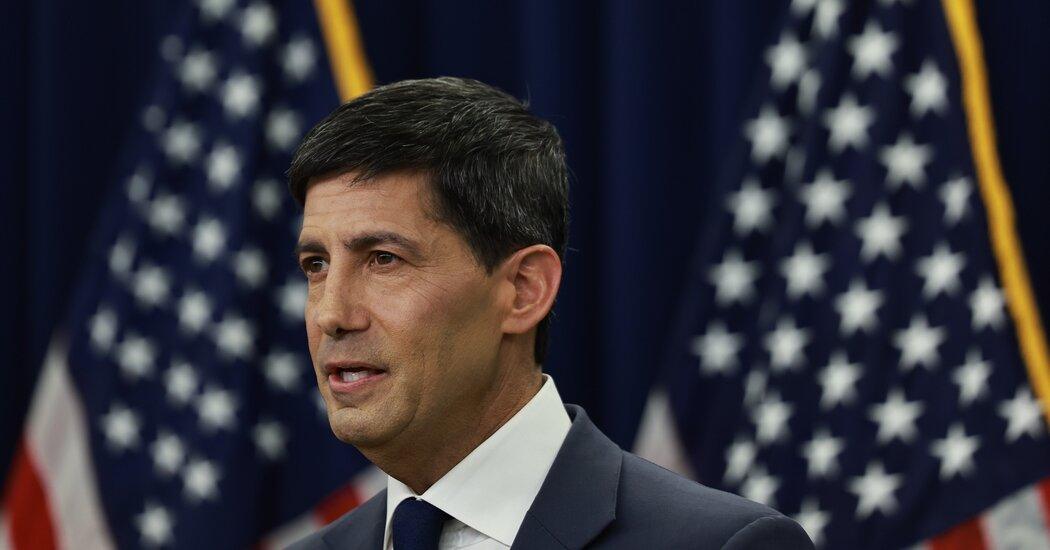
The Federal Reserve held interest rates steady and officials braced for higher borrowing costs as inflation fears dominated Kevin M. Warsh’s first meeting as central bank chairman.
The decision was made on Wednesday to keep rates within a range of 3.5 percent to 3.75 percent for a fourth consecutive meeting. supported by the 12 members of the Federal Open Market Committee. This is the first political vote since June last year without any form of opposition.
But the apparent unanimity among officials disguises the very difficult position Mr. Warsh finds himself in now that he is head of the Fed. Mr. Warsh was chosen for the position by President Trump, who has led a relentless pressure campaign on the central bank in an effort to reduce borrowing costs.
Achieving this goal has become virtually impossible because of the war with Iran and the inflationary surge it unleashed. An agreement in principle has been reached to end the conflict, but the economic blow is likely to last much longer.
Mr. Warsh’s new colleagues not only rejected the idea that rates could fall at any time, but many also welcomed the possibility that they might have to raise them to bring inflation back to 2 percent – a goal they have not reached in five years. New projections released alongside Wednesday’s rate decision highlighted the shift.
According to the latest dot plot, which tracks what policymakers think will happen to borrowing costs in coming years, about half of officials expect the Fed to increase by one or more quarter points by the end of the year. Three people predicted just one increase, while five thought the Fed should raise rates by half a percentage point. One person thought the Fed should raise rates by three-quarters of a percentage point.
Eight officials said rates could remain unchanged through the end of the year, and only one person considered a quarter-point cut.
The dot plot had fewer entries than usual. Mr. Warsh confirmed that he was the only official not to submit any projections, while another policymaker opted not to submit projections just for 2028. Mr. Warsh argued that Fed officials should speak less frequently and refrain from providing specific guidance on where short-term rates might go to avoid limiting their ability to pivot if the economic environment changes.
On Wednesday, the Fed significantly scaled back its policy statement and opted to remove a portion that previously contained guidance on the conditions under which the Fed would consider cutting rates again. This had become problematic for many officials, who preferred more neutral language indicating that a rate increase was just as feasible.
The change aligns with Mr. Warsh’s call for less open communication from the Fed about its next move. But it also likely reflects the heightened concern many officials have about the trajectory of inflation, which is hitting its highest level in three years. Even before the war, price pressures were surprisingly strong in service sectors such as hotels and transportation. A surge in spending linked to the proliferation of artificial intelligence and a booming stock market have helped ratchet up the pressure further.
Rising inflation and a stable policy rate translate into a lower inflation-adjusted or “real” interest rate, meaning the Fed is no longer restricting the economy as much as it once was. This risks making the Fed’s inflation problem even worse, especially at a time when the labor market has strengthened and the economy as a whole is holding up well.
In their new projections Wednesday, policymakers significantly raised their forecasts for inflation, as measured by the personal consumption expenditures price index, compared to three months ago. They now expect headline inflation to end the year at 3.6 percent and “core” inflation, which does not take into account volatile food and energy prices, to register a pace of 3.3 percent. According to the latest data from April, PCE inflation accelerated to 3.8 percent compared to the same period last year, while core PCE was up 3.3 percent. The Fed targets inflation of 2 percent.
They also forecast that the economy will grow steadily at 2.2 percent this year and that unemployment will remain stable at 4.3 percent.
Mr. Warsh must navigate these economic crosscurrents while trying to keep his promise to lead a “reform-oriented” Fed. His priorities include shrinking the Fed’s $6.7 trillion balance sheet and overhauling how the central bank models and measures inflation.


