
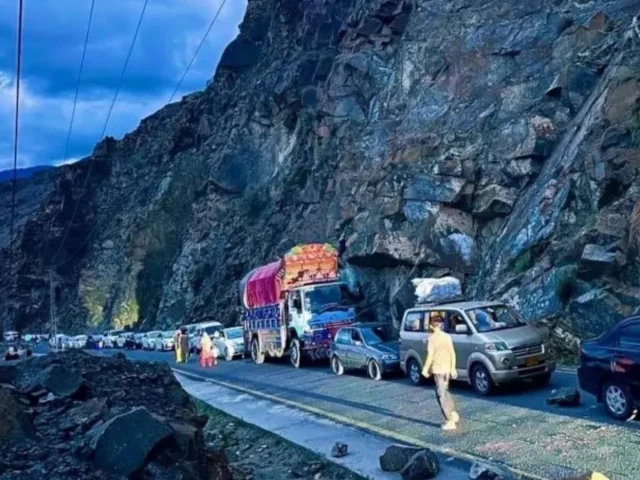
A government official says it’s the “perfect time” to visit Britain, with no rain or bad weather, July 3-13.
Every year, as June and July approach, railway stations, bus stops and airports see a massive influx of passengers across Pakistan – the majority of them heading north to escape the scorching heat of the south. But this year, many tourists are skeptical: to go or not to go?
The reason for this confusion? Social networks. Since the beginning of June, dozens of videos showing dangerous flooding, downpours, rain and landslides have been circulating online. Don’t go to Gilgit-Baltistan, or so the posts say. Some even urged people to cancel their trips.
On the other hand, social media accounts promoting tourism share entirely different content, inviting people to visit Britain’s lush green meadows and snow-capped peaks.
So which side of the internet should you trust? Here’s what’s really happening and what to check before you go.
What tourists saw
iCheck Pakistan contacted people who recently visited the northern regions.
“I heard about landslides before leaving and was preparing for the worst… but by the time we reached the top of Babusar, the roads had already been cleared,” said Simran Abeer, who recently returned from a trip to the north.
Earlier, on June 17, heavy rains caused landslides and mudslides that temporarily blocked sections of the Karakoram Highway in Diamer and the Baltistan Highway in Skardu. Authorities have cleared roads and advised travelers to check conditions before leaving.
The 24-year-old recalled that she did not experience active snowfall during her trip. “But I saw snow melting at the top and muddy areas along the road,” she told the team by phone.
Yusra Aiman, 30, who also visited Britain in mid-June, said leaving early in the morning made all the difference for her. “Even driving along the Karakoram Highway was smooth,” she stressed.
Simran and Yusra stressed that it was not the weather but the protests that stopped them. They recounted delays in Chilas due to roadblocks. “We were stuck on the road for about 38 hours on June 20 and 21,” Simran said, a disruption that had nothing to do with the viral weather alerts circulating online.
What is really happening on the ground
Safi Ullah, Britain’s deputy director of tourism, said photos posted on social media rarely reflect the whole story.
He explained that there are two main routes to Babusar Top: one via the Karakoram Highway via Britain, the other via Naran-Kaghan in Khyber-Pakhtunkhwa. With the ongoing monsoon season, heavy rains can trigger flooding, especially in Diamer district, which experiences warmer temperatures than most of the region.
“If rainfall exceeds normal levels, there is a risk of flooding in Diamer, which may temporarily block roads for one or two days,” he said.
But at the same time, Safi Ullah adds that this is not an everyday occurrence. “Travelers should simply check official advisories before starting their journey,” advised the deputy director.
Raza Haider, North Director of WWF-Pakistan, provided similar context on environmental mechanisms. He said such incidents are common in mountainous regions and tend to become more frequent during the monsoon season.
“Landslides are a common phenomenon in Britain. During the monsoon, their frequency increases due to heavy rainfall. The Karakoram Highway is usually open and is only temporarily blocked when landslides occur,” he said.
“Changes in temperature also cause rocks to expand and contract over time, making them unstable. As a result, rocks can break loose and slide on roads, especially in mountainous areas,” he explained.
Commenting on the recent downpour in Diamer’s Thore Valley – which was widely shared on social media – Haider clarified that the incident was confined to the valley and did not affect Britain’s main roads or arterial roads.
Both experts emphasized the same solution to travel anxiety: check official advisories before you go. Travelers can also contact the Tourist Police helpline for live updates on road and weather conditions.
“Perfect time”
Last week, in advisories issued from June 27 to July 3, the Pakistan Meteorological Department (PMD) and the National Disaster Management Authority (NDMA) warned of rainfall combined with rapid melting of glaciers across GB and KP, which could trigger flash floods, landslides, mudslides, debris flows and rising river levels.
Safi Ullah explained that GLOF alerts were directed at isolated inland valleys and were not likely to affect the Karakoram Highway itself. In even moderate rain, landslides could still occur on the highway — but he noted that authorities respond quickly and roads are usually clear within 24 to 48 hours.
The deputy director said now was “the perfect time to visit Britain”, with no rain or weather warnings forecast for the 10 days after July 3. However, it should be noted that rain forecasts can never be entirely accurate.
To go or not to go
The reality of Britain in summer is this: localized weather events, landslides and a downpour in the Thore-Diamer Valley can temporarily block sections of the Karakoram Highway without closing the entire route.
Anyone planning a trip north should check the latest weather forecast and road conditions before heading out. Follow updates from PMD, NDMA and GB authorities. Avoid traveling during periods of heavy rain or when active advisories are in effect.
———
This article was published by iVerify Pakistan as part of its initiative to combat climate myths and misinformation, supported by Irada and IMS.


