
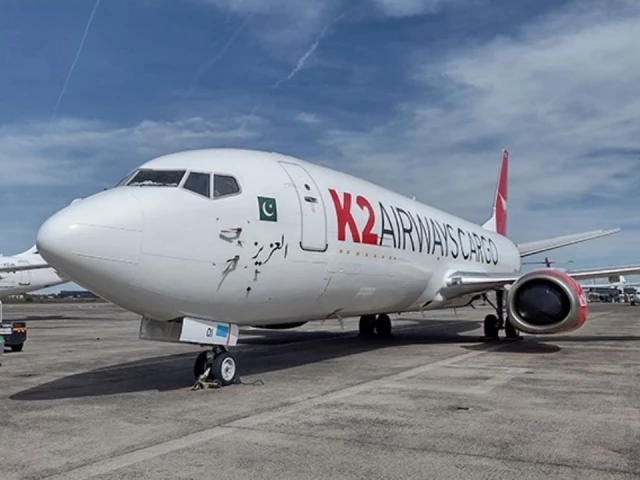
A photo of a K2 Airways plane. — K2 AIRWAYS WEBSITE
KARACHI:
Pakistani authorities are considering hiring foreign deep-sea rescue specialists to assist in the recovery of the missing K2 Airways cargo plane that crashed into the Arabian Sea off the coast of Ormara, as efforts continue to locate the plane’s crew, fuselage, engines and black box.
According to sources, the Bureau of Aircraft Safety Investigation, which is leading the investigation into the accident, has proposed to the government to hire internationally experienced salvage companies for the technically complex deep-sea recovery operation.
Following government deliberations, cooperation with international specialist rescue organizations is expected to pave the way for an advanced underwater recovery effort.
The search operation continued on Sunday, with the Pakistan Navy and the Pakistan Maritime Security Agency carrying out coordinated operations in the crash area off the Balochistan coast near Ormara.
Sources said it was decided to continue search operations in a sustained manner using naval assets deployed in the area.
So far, search teams have recovered the plane’s tail and a bag belonging to engineer Hamid, while efforts to locate the plane’s crew, fuselage, engines and black box are still ongoing.
Relatives are calling for an international search effort to find the flight recorders to determine the cause.
Affected families also received an official response via the Prime Minister’s portal after submitting an application. Under the portal mechanism, a representative from a human rights organization in Karachi was appointed to coordinate and assist the affected families.
The families had also submitted a petition regarding the accident through the Pakistan Senate portal.
Debris from the K2 Airways cargo ship was recovered shortly after the July 7 crash, but the water in the area is about 3,000 meters deep.
Finding the “black boxes” would require a costly underwater search likely to require foreign assistance, according to aviation experts familiar with deep-water accidents such as that of the Air France 447 in 2009.
The 27-year-old plane’s tracking beacons were designed to transmit pings for only 30 days. Recovery of the recorders could show whether a navigation system problem reported shortly before the crash was related to a navigation component that relatives say had been replaced before the flight.
Authorities have provided no public updates on the search for a week, and an industrial company specializing in underwater searches told Reuters it was not aware of any requests for help from foreign companies or navies.
“The search must continue and all resources that can be deployed, locally and internationally, must be deployed,” Yashib Rizwan, the eldest son of Captain Rizwan Idris, told Reuters. “For us, a transparent investigation is essential.”
Engineer Muhammad Arif Siddiqui’s son, Abdur Rafay Siddiqui, also called for international help if needed.
Both families held funeral prayers after losing hope that the bodies would be found.
The government did not respond to questions about whether it would seek foreign help in searching for the plane.
K2, which lost its only plane in the crash, did not respond to requests for comment.
One of the plane’s two inertial reference units (IRUs), which transmit information about the plane’s position, speed and orientation to the cockpit displays, was replaced in Sharjah, said the captain’s son, Yashib Rizwan.
“If you have a problem with your IRU, you just can’t rely on the instruments,” said John Goglia, a former member of the U.S. National Transportation Safety Board, adding that pilots flying at night over the ocean without visual references might have trouble determining the plane’s orientation.
Airplane accidents are usually caused by several factors, and it remains unclear whether IRU replacement is related to the accident.
A malfunction in the inertial reference system contributed to the Adam Air crash in Indonesia in 2007, where investigators found the pilots were obsessed with troubleshooting faulty information, failed to notice a steep right bank and lost control before the plane plunged into the sea, killing all 102 people on board.
Pings from Adam Air’s black boxes were detected about three weeks after the accident during a search aided by the U.S. Navy, but recovering the recorders from about 2,000 m of water required a multimillion-dollar effort over several months using a specialized remotely operated vehicle.
U.S. aviation expert Todd Curtis said on the “Flight Safety Detectives” podcast that Pakistan was unlikely to mount a similar recovery operation unless there was a compelling reason, given that the K2 plane was an aging cargo plane rather than a current production passenger model. (Contributed by Reuters)


