
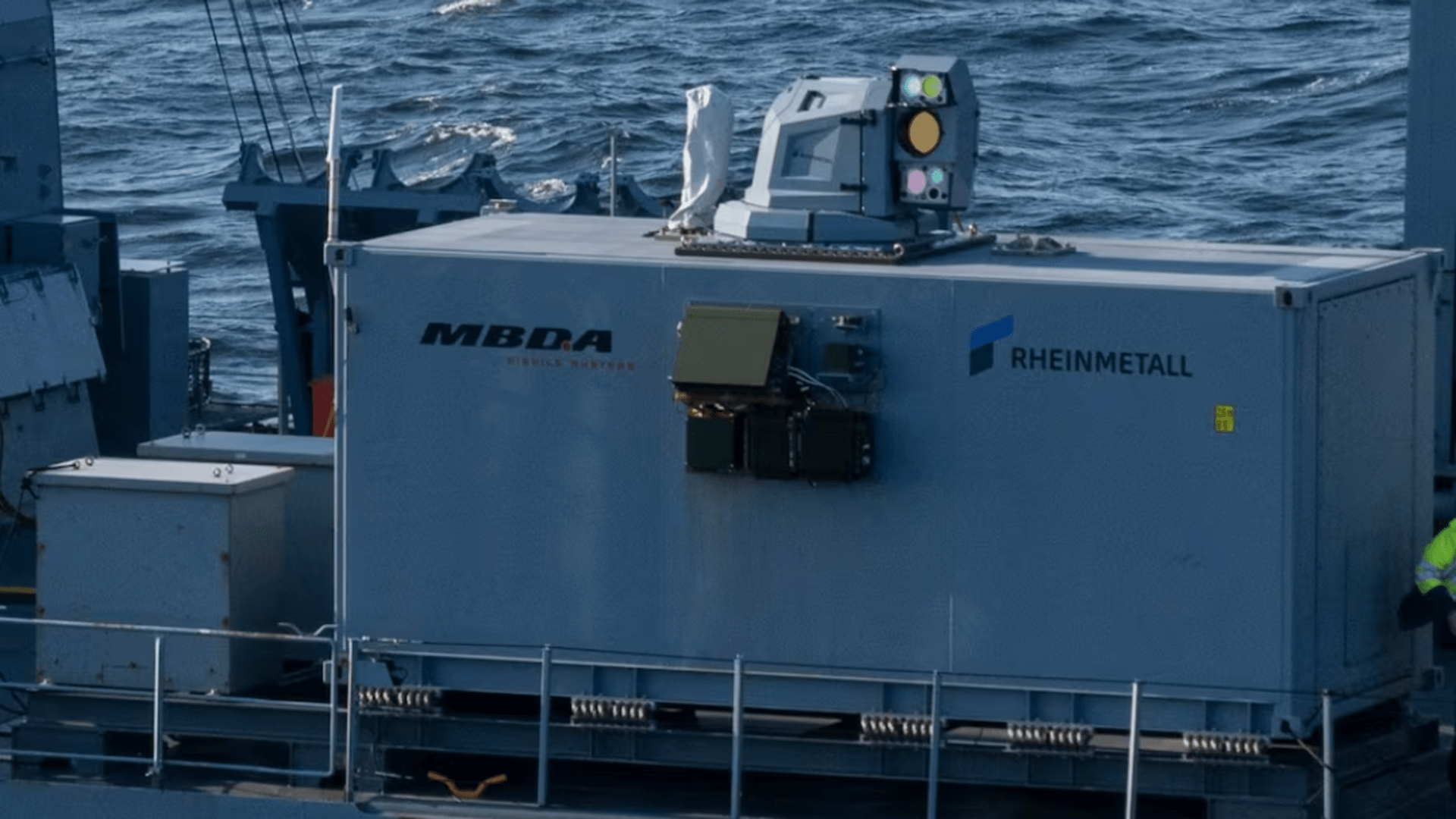
- Germany advances naval laser weapon towards operational deployment by 2029
- Future 100 kW laser aims to counter faster, bigger aerial threats
- More than 1,000 laser shots validated performance during extended naval trials
Germany has confirmed plans to deploy a high-energy laser weapon aboard military ships by 2029, aimed primarily at intercepting drones.
Defense companies Rheinmetall and MBDA signed a contract worth several hundred million euros in June 2026 to build the complete system.
The program follows years of testing on a demonstrator aboard the frigate Sachsen, which fired more than 1,000 shots during testing.

From demonstrator to deployable weapon
The demonstrator currently operates at around 20 kilowatts, sufficient to neutralize small drones and light surface targets near military ships.
Future versions are expected to exceed 100 kilowatts, a substantial increase intended to counter larger and considerably faster aerial threats.
During testing, the demonstrator traveled approximately 28,000 nautical miles between the Baltic Sea and the Mediterranean for more than a year.
Another phase of testing included more than 100 live firings in maritime conditions, examining tracking accuracy, reaction speed and engagement performance against fast-moving drones.
“The laser weapon system will provide our personnel deployed on military ships with a significantly higher level of protection, especially when it comes to countering drones,” said Roman Koehne, head of Rheinmetall’s weapons and munitions division.
Beyond combating drones, engineers hope the technology could eventually intercept guided missiles, rockets and even artillery shells fired from a considerable distance.
Company officials say the system has also demonstrated the ability to strike targets located in the open rather than on solid ground.
British, French and Belgian forces are seeking similar systems – a broader push toward directed energy weapons in European navies more generally.
The British Royal Navy, for example, already plans to install its DragonFire laser weapon aboard a destroyer by 2027.
Similarly, Belgium has committed €3.1 billion to multi-tiered air defenses, including Skyranger 30 systems, GM200 radars and 10 NASAMS batteries.
Costs, sovereignty and unresolved questions
The German program places a strong emphasis on domestic supply chains, with mass production expected to take place largely in Germany.
MBDA Deutschland Managing Director Thomas Gottschild described the containerized system as an affordable option for monitoring ports and other secure facilities.
Neither company has disclosed a final unit price, leaving open the question of how affordable the weapon will prove over full production.
Scaling the laser from 20 kilowatts to over 100 kilowatts presents significant thermal and power generation challenges aboard confined naval platforms.
However, officials believe the military ships offer enough electrical power, cooling capacity, sensors and space for demanding laser weapon systems.
Both companies describe the technological readiness level of the system as very high, citing more than a year of continuous onboard testing in real-world conditions.
Procurement officials have not specified interim milestones, making it still difficult to assess whether the 2029 target remains realistic at this stage.
Additional testing remains necessary before acquisition, but recent steps suggest that European navies now view directed energy weapons as practical complements to existing missiles and cannons.
Via Defense News
Follow TechRadar on Google News And add us as your favorite source to get our news, reviews and expert opinions in your feeds. Make sure to click the Follow button!
And of course you can too follow TechRadar on TikTok for news, reviews, unboxings in video form and receive regular updates from us on WhatsApp Also.


