
DPM, PPP chief reject Delhi’s suspension of IWT Ministers pledge to defend country’s water rights Experts urge W
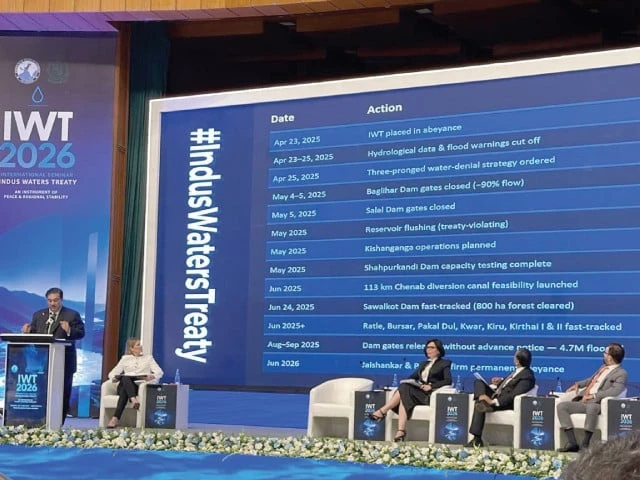
A giant video wall highlights India’s violations of the Indus Waters Treaty since April 2025 during a presentation at a seminar titled ‘Indus Waters Treaty: An Instrument of Peace and Regional Stability’ in Islamabad. Photo: PTV
ISLAMABAD:
Political leaders on Tuesday pledged a vigorous defense of Pakistan’s rights under the Indus Waters Treaty (IWT) through all available legal and diplomatic means, warning that any attempt to deprive the country of its share of water would have “profound consequences for regional peace and security.”
International political leaders, ministers, legal experts and academics also urged the international community to reject water militarization and respect the sanctity of international treaties at an international treaty seminar held in Islamabad.
The seminar was addressed by several federal ministers, including Ishaq Dar, Attaullah Tarar and Musadik Malik, Pakistan People’s Party (PPP) Chairman Bilawal Bhutto Zardari, Pakistan Indus Water Commissioner Mehar Ali Shah, policy experts from the United States, China and Russia, and other speakers.
Speakers at the seminar, titled “Indus Waters Treaty: An Instrument for Peace and Regional Stability,” urged the international community to respect the treaty, reject the militarization of water and ensure that disputes are resolved through established legal and diplomatic mechanisms rather than unilateral action.
Deputy Prime Minister and Foreign Minister Ishaq Dar said the six-decade-old IWT cannot be unilaterally suspended or terminated. He expressed concern over the sudden changes in the Chenab and Jhelum rivers since April 2025 and said the disputes must be resolved through the mechanisms established by the treaty.
He called India’s decision last April to suspend the treaty “illegal, unilateral and without any basis”, adding that Pakistan had unequivocally rejected the announcement. “No party can unilaterally suspend or terminate its obligations under a treaty that contains no such provision,” he said.
Dar said uninterrupted flow of western rivers was vital for Pakistan’s agriculture, food security, energy production and economic development. He warned that failure to respect international agreements whenever they became politically inconvenient would weaken confidence in the international legal order.
Recalling the position of the National Security Committee following India’s decision, the Deputy Prime Minister warned that any diversion, interruption or reduction of Pakistan’s water rights under the treaty would be treated as an act of war.
“We sincerely advise India against sowing the seeds of war and jeopardizing peace and security in the region,” he said, adding that Pakistan remained committed to dialogue and peaceful resolution of disputes, but there should be “no misunderstanding” about its determination to safeguard its water rights.
PPP Chairman Bilawal Bhutto Zardari also described India’s decision to suspend the treaty as “not only a bilateral dispute, but a challenge to international law, world peace and the rights of downstream states.” He called for a new international convention against the militarization of waterways.
“International law should explicitly prohibit states from exploiting civilian dependence on shared rivers,” he said. “Water is not a weapon. Thirst is not diplomacy. Starvation is not the art of government,” he added, arguing that no upstream state should be allowed to hold downstream populations hostage by manipulating shared waterways.
Bilawal urged Pakistan to simultaneously pursue legal, diplomatic, humanitarian, climate and deterrence efforts while continuing to strengthen national water security through reservoirs, dams, canals and flood protection projects.
Comparing the Indus River with the Strait of Hormuz, Bilawal said lasting peace between Pakistan and India could not be achieved as long as the treaty remained pending. He said the IWT was much more than a water-sharing agreement and had been a cornerstone of regional peace and stability for decades.
Information Minister Attaullah Tarar said Pakistan was not just discussing a treaty but “the lifeline of more than 240 million people.” Describing the Indus as a central part of Pakistan’s identity and civilization, he said the people of the country had an inalienable right to its waters.
He said international agreements could not be modified, revoked, suspended or put on hold unilaterally, stressing that the treaty had endured wars and protracted political tensions for more than six decades because it reflected the principles of good faith and peaceful resolution of disputes.
“The militarization of water undermines regional peace, stability and cooperation,” he said, reiterating that Pakistan remained committed to peaceful engagement and constructive dialogue, but would protect its water rights through all available legal means.
Climate Change Minister Musadik Malik cited repeated fluctuations in water flows and the experience of a Pakistani farmer displaced by successive floods, saying the problem was affecting the livelihoods, food security and rights of people downstream.
Malik warned that if the IWT could be unilaterally ignored, confidence in the international treaty system itself would be undermined. He called for a binding international pact on transboundary water governance, which would have political, economic and diplomatic consequences.
Pakistan’s Indus Water Commissioner Mehar Ali Shah said the treaty aims to prevent conflicts and keep water-related conflicts out of politics. Terming the Permanent Indus Commission as the “early warning system” of the treaty, Shah said Pakistan had continued to fulfill its obligations by sharing data.
He told the seminar that repeated communications with India on the matter had gone unanswered, adding that the absence of timely information made it difficult for downstream states to distinguish between natural conditions of rivers and upstream operations.
Referring to repeated fluctuations in the Chenab River since April 2025, Shah said sudden changes in water flows complicate flood forecasting, disrupt irrigation planning and increase strategic risks.
Former Justice Minister Ahmer Bilal Soofi called for dialogue between legal experts of the two countries within established legal frameworks. Former defense minister Khurram Dastgir Khan accused India of “weaponizing water”, saying it was threatening millions of people who depend on the Indus Basin.
He discussed measures such as suspension of hydrological data sharing, closing of gates of Baglihar and Salal dams, acceleration of water projects and actions affecting river flow. He urged the international community to respect the principle that shared rivers should never be used as instruments of coercion.
Several international experts participating in the seminar echoed similar concerns. Laurie Watkins, a US policy expert, said the withholding of hydrological data and failure to respond to correspondence from Pakistan violated the principles of customary international law.
Dr Roxolana Zigon, from the University of World Civilizations in Moscow, described the Indus Waters Treaty as internationally recognized for its durability and praised Pakistan’s restraint despite heightened tensions.
Professor Victor Gao of the Center for China and Globalization called India’s suspension of the treaty a “crime against humanity”, while Ambassador Jauhar Saleem, president of the Institute of Regional Studies, said sustainable water security depends not only on the availability of water, but also on certainty, transparency, predictability and cooperation.
The seminar concluded with participants reaffirming that the Indus Waters Treaty remained the cornerstone of regional peace and stability. Speakers argued that transboundary rivers should serve as instruments of cooperation rather than confrontation.
(WITH APPLICATION INPUTS)


