NEWYou can now listen to PK Press Club articles!
EXCLUSIVE: Iran’s Islamic Revolutionary Guard Corps (IRGC) allegedly used the country’s soccer system to spy on citizens, potentially violating FIFA statutes, according to a new report from a major opposition party.
The US office of the National Council of Resistance of Iran (NCRI) provided the report to PK Press Club Digital. It describes an alleged plot to integrate Iran’s football federation and top clubs into a broader state security apparatus, and says at least 15 IRGC commanders have been officially documented and identified in the leadership of football clubs.
The NCRI, citing alleged official IRGC documents, accuses the IRGC of using clubs, stadium infrastructure and security-related leadership positions to monitor fans, repress dissident athletes and violate FIFA rules on political interference.
CLICK HERE FOR MORE SPORTS COVERAGE ON PK Press Club
The report alleges that facial recognition technology and other tracking devices and systems were used to monitor spectators. The report cites purported Iranian internal security documents, including Tehran Provincial Security Council documents from 2025 and a security plan for Sarallah headquarters from 2024.
According to NCRI-US translations of these documents, officials discussed facial recognition cameras in the Azadi, Takhti and Shahr-e Quds stadiums; a ticket office linked to the national Iranian civil registration database; seat-by-seat mapping of spectators by national identity card; monitoring and verification of fan club leaders; and designated police assembly areas or rapid reaction units inside stadiums.
“It is extremely critical that security, intelligence and law enforcement agencies use and exploit the Azadi Complex’s video surveillance cameras during matches, given the constant potential for unpredictable security incidents. It is highly conceivable that future riots and civil unrest could occur inside sports stadiums,” the report said, citing the documents.
PK Press Club Digital has contacted the Islamic Football Federation of Iran and the Iranian Mission to the United Nations for comment.
OLYMPIANS UNITE TO SPEAK OUT AGAINST IRAN FOR EXECUTION OF COUNTRY’S STAR ATHLETES
NCRI-US is the Washington office of the National Council of Resistance of Iran, an Iranian opposition coalition that advocates replacing the Islamic Republic with what it describes as a democratic, secular, non-nuclear republic. The group says the documents were obtained through the Iranian network of the People’s Mojahedin Organization of Iran, or MEK, a major opposition movement that Tehran considers an enemy.
Alireza Jafarzadeh, deputy director of NCRI-US, told PK Press Club Digital that the organization initially focused on monitoring stadiums, while tracking how Iranian authorities identified protesters during recent uprisings.
“Our goal was basically to focus on the protests and see how the Iranian regime [was] “I tried to identify the protesters in the streets, to identify the leaders of the protests,” Jafarzadeh said. He said the NCRI later realized, while reviewing what he described as a large number of internal documents, that “when it comes to a sports field, the Iranian regime pays special attention to sports as a means of repression.”
Jafarzadeh added that Iranian football stadiums are among the few spaces where large numbers of young people gather and express their collective emotions, making them a target for security forces. Football is Iran’s most popular sport, and clubs such as Persepolis and Esteghlal attract huge followings.
According to the NCRI report, the minutes of a meeting of the sports commission of the Tehran Provincial Security Council in May 2025 discussed the need to equip several Azadi, Takhti and Shahr-e Quds stadiums with facial recognition cameras.
The same document states that the cooperation of the Football Federation, the Football League Organization, Esteghlal and Persepolis was “strictly required” for the Azadi Stadium video surveillance project, according to the NCRI. Another section cites Iranian football federation president Mehdi Taj among officials copied for “executive implementation.”
The report also cites the minutes of a subsequent session of the Tehran Provincial Security Council, according to which officials discussed smart ticketing connected to the Iranian National Civil Registration Organization, mandatory identity verification, numbered seats corresponding to national identification numbers, facial recognition cameras, X-ray scanning devices and “fan cards” for pre-selected fan leaders.
Jafarzadeh said the NCRI believes the purpose of collecting such information is to identify people who oppose the regime and enable subsequent arrests.
IRAN REGIME USES WAR TO HIDE “BRUTAL” WAVE OF EXECUTIONS AGAINST POLITICAL OPPONENTS
Iranian football fans gathered at Enghelab Square in Tehran on May 13, 2026 for a ceremony honoring the Iranian national football team ahead of the 2026 FIFA World Cup. The event included performances of anthems dedicated to the team and the unveiling of the team’s kit. (Fatemeh Bahrami/Anadolu)
“The information they obtained from sports facilities was used to identify people opposed to the regime and then arrested them,” Jafarzadeh said. “The regime uses sports and sporting events to exert its repression on the population.”
The report further alleges that the Iranian football system has been infiltrated by the IRGC and security-related figures for decades. The NCRI names at least 15 people it describes as IRGC or security-related figures who have held management positions in clubs, federations, league management or sports bodies. Among them, the report identifies Taj as a former IRGC intelligence officer who currently heads the Iranian football federation.
FIFA’s official statutes state that member associations must “manage their affairs independently”, ensure that their affairs are not influenced by third parties, be “neutral in matters of politics and religion”, “independent” and avoid “all forms of political interference”.
Jafarzadeh said FIFA should expel Iran’s soccer federation, comparing the matter to international sports bans imposed on South Africa during the apartheid era.
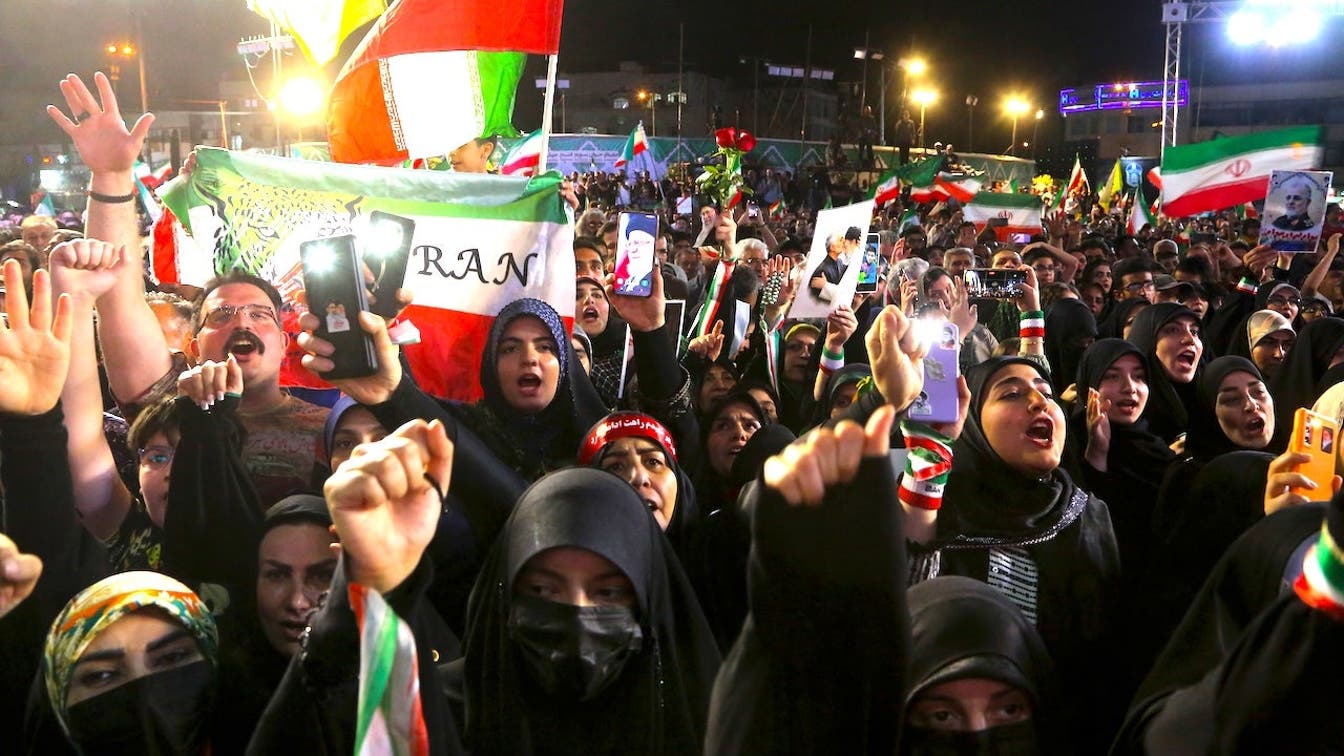
Iranian football fans gather at Enghelab Square in Tehran during a ceremony for the Iranian national football team ahead of the 2026 FIFA World Cup, May 13, 2026. (Fatemeh Bahrami/Anadolu)
“You cannot have a sports club, a sports facility, dominated by the military, which is part of the Iranian regime,” he said. “Sports federations must be able to operate autonomously, independently of the government…
“My message to FIFA is to do exactly what you did with South Africa during apartheid. The Iranian Football Federation, controlled by the Revolutionary Guards, must be expelled from FIFA.”
FIFA also says violations of this independence requirement can result in sanctions, even if the outside influence is not the association’s fault.
PK Press Club Digital has contacted FIFA for comment.
The report also accuses Iran of systematic gender discrimination in sports, particularly restrictions on women’s entry into stadiums and state control over female athletes’ uniforms.
Human Rights Watch reported in 2022 that Iranian authorities blocked dozens of women from entering a soccer stadium in Mashhad. However, FIFA also highlighted recent cases in which women were allowed to attend Iranian matches, including in 2024, at a women-only Persian Gulf Professional League match in Isfahan.
Rights groups say Iranian women continue to face discriminatory barriers to stadium access.
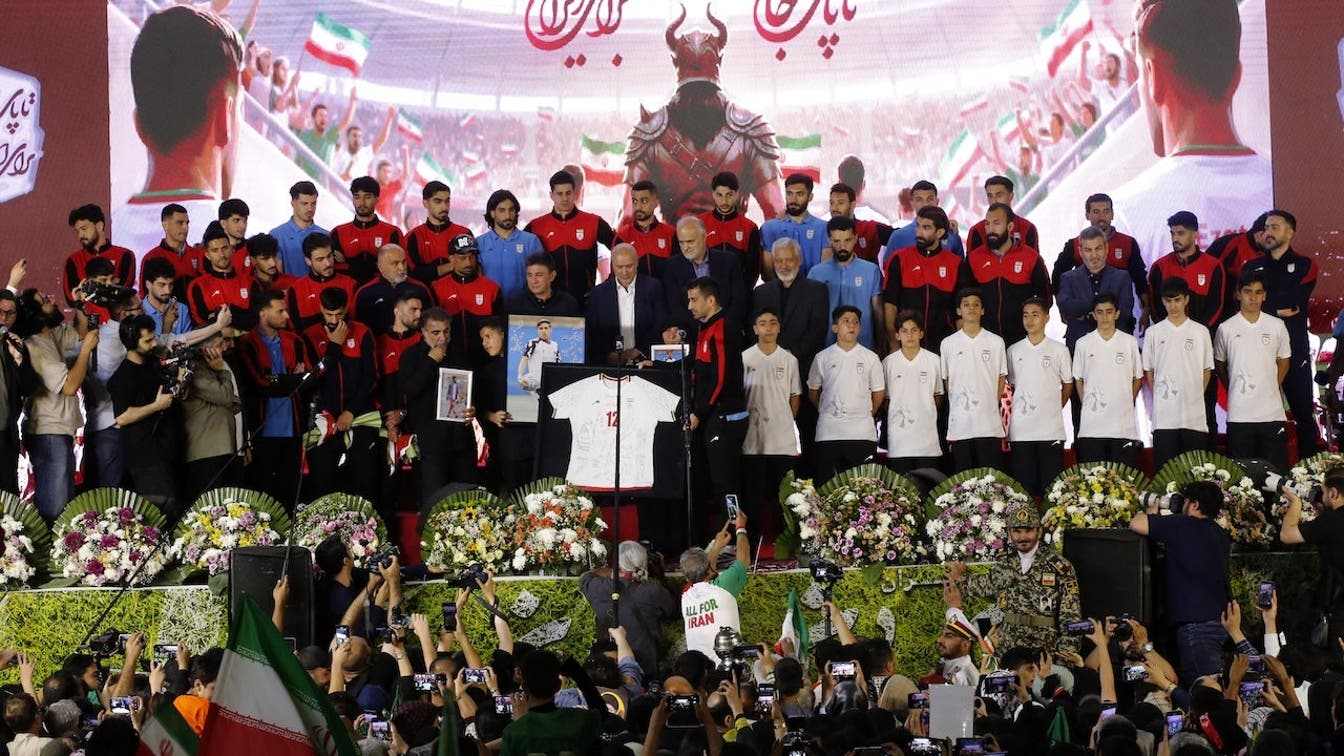
Iranian football fans gather at Enghelab Square in Tehran during a ceremony for the Iranian national football team ahead of the 2026 FIFA World Cup, May 13, 2026. Thousands of people attended the event during which anthems dedicated to the national team were performed and the team’s kit for the tournament was unveiled. (Fatemeh Bahrami/Anadolu)
Rights groups have documented cases in which Iranian athletes were punished after supporting or participating in anti-government protests.
Habib Khabiri, a famous former Iranian football player and captain of the Iranian national team, was listed in a 1985 United Nations report among those “allegedly summarily and arbitrarily executed” in Iran in 1984-1985. Radio Free Europe/Radio Liberty reported that Khabiri was arrested in 1983, tortured in prison and executed in 1984 for alleged links to the People’s Mojahedin.
CLICK HERE TO DOWNLOAD THE PK Press Club APP
Jafarzadeh presented Khabiri as a symbol of the regime’s repression of athletes, as Khabiri was a rising soccer star who became captain of the Iranian national team before being arrested and asked to appear on television to renounce his political beliefs.
“He refused and he was executed on June 21, 1984,” Jafarzadeh said. “He has become a symbol for all athletes.”