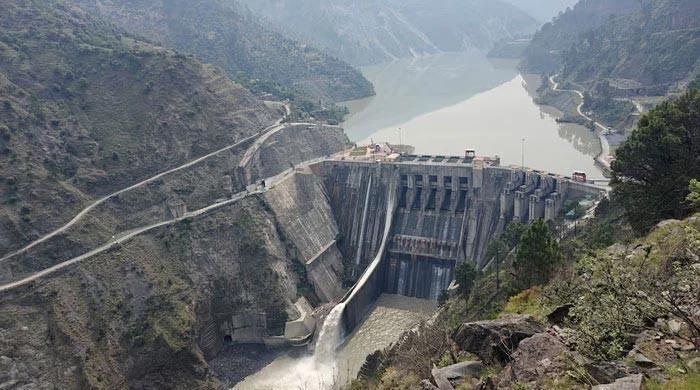
The crime: India has turned water into a weapon. On April 23, 2025, following the Pahalgam terrorist attack, India unilaterally suspended the Indus Waters Treaty – a treaty that had survived four full-scale wars and sixty-five years of uninterrupted enmity between two nuclear-armed states.
Then came the threats. “We will ensure that not a single drop of water from the Indus flows into Pakistan,” Indian Water Minister Patil said in April 2025. “No, [IWT] will never be restored,” Indian Home Minister Shah said a month later. Prime Minister Modi first said in 2016 and has since repeated that “blood and water cannot flow together.” “punitive action”. By doing this, even if the strangulation is short-lived, we demonstrate that we will take coercive measures… The water from the Chenab River irrigates the agricultural lands of Punjab, and Pakistan must understand that we intend to punish them on all fronts.
Strangling, punishing and coercing is therefore the policy of India. Choking rivers. Punish and coerce 200 million people not for what they did, but for what their government is accused of without any evidence. India’s interior minister said that India would “never” restore the IWT and that “we would transport the water that was flowing to Pakistan to Rajasthan by building a canal.” Pakistan will be deprived of the water it receives unjustifiably.”
The Indian government has publicly declared its intention to deprive the neighboring population of water. Leave this alongside the Universal Declaration of Human Rights, which recognizes water as a fundamental human right. Let it sit next to the Geneva Conventions. Let it be placed alongside all the principles of civilized international conduct that humanity has constructed. Pakistan’s legal position is undoubtedly anchored in international law. The Hague Court of Arbitration noted in June 2025 that the treaty does not provide for unilateral suspension and reaffirmed its jurisdiction. India’s response? He declared the tribunal “illegal” and refused to participate. When a state loses the legal argument and responds by disavowing the court, that state has admitted its own guilt.
The 1997 UN Watercourses Convention requires equitable and reasonable use and the absence of significant harm. According to Article 62 of the Vienna Convention, political tensions, including terrorism, do not constitute a fundamental change in circumstances that alters the water sharing objective of the treaty. This is precisely what the International Court of Justice ruled in its 1997 Gabcíkovo-Nagymaros ruling on rights to the waters of the Danube between Hungary and Slovakia.
India’s militarization of water could amount to collective punishment under international humanitarian law, prohibited by the Geneva Conventions and, due to the threat of mass starvation, potentially a crime against humanity under the Rome Statute. The deal is done. The verdict, whatever the honest reading of international law, is already written. India is doomed. The militarization of water is a crime beyond laws and treaties. Putting the IWT on hold means attacking a vital watershed on which 200 million Pakistanis depend for their lives. These are not abstract statistics. They are farmers of Punjab whose wheat feeds a nation. These are mothers from Sindh whose children drink from canals fed by melting snow from the Himalayas. They are fishermen whose entire livelihood relies on the river.
Professor James Scott wrote that rivers, in the long term, are alive: they are born; they change; they change the channel; they forge new routes to the sea; they move both gradually and violently; they can teem with life; they can die an almost natural death; they are frequently mutilated and even murdered. The Indus, Jhelum and Chenab are alive. India is trying to kill these living beings. “Suspension” is not a technical matter; it is a murder weapon that enters millions of Pakistani homes and pulls the trigger.
Robert Macfarlane also argues that rivers are alive. He cites New Zealand’s Te Awa Tupua Act 2017, which recognizes that the Whanganui River is not only alive but also a legal entity, giving it the same legal status as a citizen. Professor Macfarlane insists that we stop using the word ‘it’ to refer to rivers, as this reduces them to the status of things. The Indus is not a thing. Chenab is not a trick. Jhelum is not a trick. The rivers of the Indus Basin are not tricks. They are the soul of our land.
Pakistan calls on the international community – every state that has signed the UN Charter, every institution claiming to uphold the laws of nations – to act. Hold India accountable and uphold the principle that water cannot be weaponized. Water treaties cannot be dissolved by the stronger party because it wishes to stifle, punish and coerce. These 200 million Pakistanis are not a bargaining chip.
The Indus has been flowing for ten thousand years. It nurtured the Indus Valley Civilization – one of the oldest and most sophisticated human societies in history – long before Delhi existed. Professors Scott and Macfarlane understand something that the Delhi warmongers do not: a river is a living thing, not a pipe. You can’t turn it on and off like political theater requires. There is no title to the rivers, neither in international law nor in nature. The rivers of the Indus basin do not belong to India. Rivers belong to the millions of lives they support. And not just human life. Our understanding of rivers must extend to tributaries, wetlands, floodplains, backwaters, eddies, swamps and mangroves, to all life forms that depend on rivers for their existence.
India cannot put any river on hold. India cannot hold water hostage. India cannot starve a civilization into compliance. India cannot use rivers as weapons. Pakistan has decided that we will protect our rivers. Pakistan will protect life and civilization. Our people and their armed forces have defended this land in four wars. We will fight against India’s attempt at hydro-hegemony. We seek peace, but we will fight this war if it is imposed on us.
We will take this fight to international courts and councils, to the tribunal of world opinion, and to the consciences of citizens everywhere – until the militarization of water is condemned and banned, international law is restored, and justice flows as freely as the rivers that nourish the Indus civilization.
Quaid-e-Azam built a nation on this soil. But the rivers have written, are writing this moment and will write with their current the autobiography of this soil. Let them flow.
The writer is a former Federal Minister of Foreign Affairs and Defense. This is an edited text of a speech delivered at the recent Indus Waters Treaty conference in Islamabad. He tweets/posts @kdastgirkhan
Disclaimer: The views expressed in this article are those of the author and do not necessarily reflect the editorial policies of PK Press Club.tv.
Originally published in The News