At a press conference in Geneva, WHO Director-General Tedros Adhanom Ghebreyesus said that more than a month after the outbreak began: Frontline responders have expanded care and testing at unprecedented speed, but conditions on the ground remain challenging.
“It is encouraging that since the outbreak was first reported five weeks ago, the response has ramped up significantly,” he said.
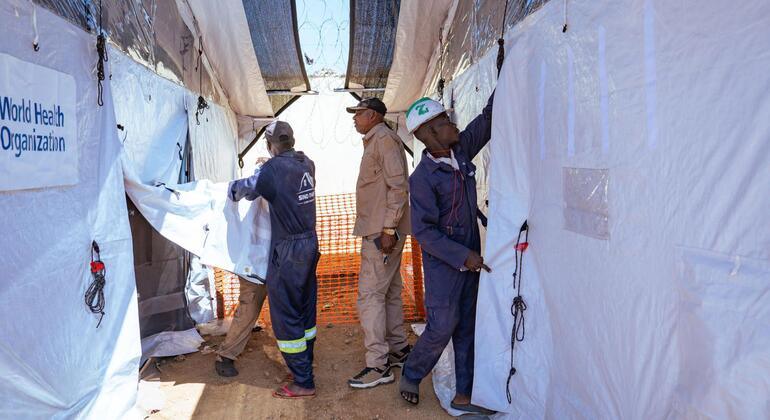
In just over a month, treatment capacity increased from fewer than 10 beds to more than 500 in 19 health centers, while laboratory testing capacity increased from 30 tests daily in the capital Kinshasa to more than 2,000 tests each day in nine laboratories across three provinces.
Early diagnosis
Tedros said communities are increasingly seeking more information and assistance to stay safe.
“More and more communities are becoming aware of the risks of Ebola and are demanding the tools and support needed to protect themselves.“, he said.
More than 100 people have recovered so far, raising hope that early diagnosis and supportive care can save lives.
But the scale of the needs remains immense. “There is now 1,094 confirmed cases, with 277 deaths“, Tedros said. “The epidemic continues to evolve rapidly.”
Meanwhile, neighboring Uganda has reported 20 confirmed cases, with two confirmed deaths.
New treatments
WHO and its partners are now preparing to launch a clinical trial next week in the DRC to test whether two antiviral treatments, MBP134 and remdesivir, can reduce mortality from Bundibugyo virus disease.
“We could save many more lives with therapies,” Tedros said.
Communities are actively consulted and informed about the trial process, and plans are underway to ensure affected populations can access treatment if it proves effective.
Improve access
Yet beyond medicine, health officials have warned that humanitarian conditions continue to hamper the response.
Tedros stressed that political action is urgently needed to improve humanitarian access and enable health teams to reach people in affected areas.
“Political advocacy and action are essential to create the conditions for increased humanitarian access and a strengthened response.“, he said.
Risks faced by stakeholders
Health workers themselves have paid a heavy price. On Wednesday, a humanitarian worker in France from the medical NGO ALIMA tested positive for the Ebola virus upon his return from treating patients in the DRC.
Nearly 80 health workers were infected during the outbreak. “This case is a reminder of the risks faced by front-line responders,” Tedros said.
WHO is urging countries to support safe deployment measures for humanitarian personnel, including better risk communication, better infection prevention and better evacuation preparation.
Despite isolated international cases linked to the outbreak, the agency maintains that the overall risk to the rest of the world remains low.
Obstacles persist
Major obstacles persist in the affected region: contact tracing remains insufficient, processing centers are under pressure, safe and dignified burials remain difficult to achieve, border closures continue to slow operations, and repeated security incidents complicate access.
The outbreak is unfolding against the backdrop of what Tedros described as a decades-long humanitarian crisis.
Earlier this month, WHO and the Africa Centers for Disease Control and Prevention (CDC) launched a joint continental preparedness and response plan requesting $518 million to strengthen efforts in affected areas and neighboring countries.
With updated funding data expected next week, humanitarian agencies hope the international response will match the urgency felt by communities still facing one of the region’s most serious public health emergencies.