
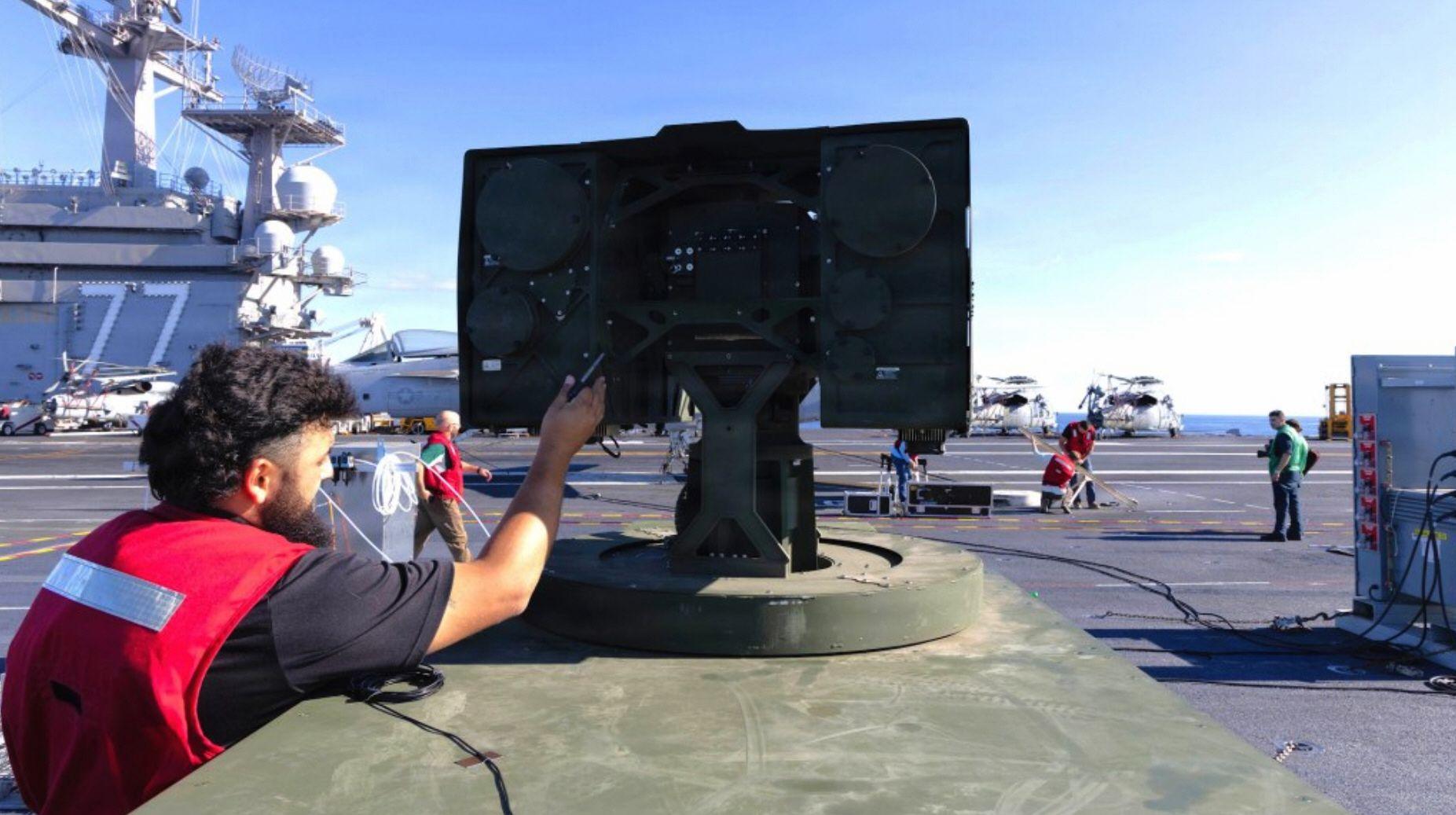
- LOCUST laser tested aboard USS George HW Bush during live drone engagement
- Palletized system deployed without permanent modification to the vessel during the demonstration
- Newer versions of Locust introduce AI-assisted tracking and higher power output
Drone warfare has grown rapidly in recent years, with large numbers of low-cost systems being used in conflicts such as Ukraine and in operations linked to Iran.
Defending against repeated drone attacks has exposed the limitations of traditional interceptors, leading the U.S. military (and others) to explore laser weapons capable of firing repeatedly without running out of ammunition.
AeroVironment claims to have successfully demonstrated its LOCUST laser weapon system aboard the aircraft carrier USS George HW Bush during a live-fire exercise conducted with the US Navy and US Army Rapid Capabilities and Critical Technologies Office.
Article continues below
Intended to counter small drones
The palletized LOCUST laser weapon system was deployed on the carrier and tracked, engaged and neutralized multiple unmanned aerial vehicles, showing the system could operate from a moving carrier environment.
The high-energy laser is mounted in a turret that can be rolled across different platforms. This design allows the system to operate either from its own battery bank or draw power directly from a vessel, reducing the need for permanent installation work.
“LOCUST provides effective all-domain protection against emerging drone threats at the speed of light — on any platform, in any domain, for any mission,” said John Garrity, vice president of Directed Energy Systems at AV.
“Rolling LOCUST onto a ship and quickly launching operations facilitates the widespread use of high-energy lasers throughout the fleet without the need for costly and time-consuming ship modifications. This is a game-changer for the Navy and for our national security.”
AeroVironment said the system demonstrated target tracking and beam control while operating aboard the aircraft carrier, and that the same basic system architecture is shared across multiple military services, so the technology can be used on land vehicles as well as ships.
The war zone said this appears to be the first time a laser weapon of this type has been installed on a US aircraft carrier, and that systems like LOCUST typically operate in a power range of around 20 kW. This places them in the category of weapons intended primarily to counter small drones.
TWZ also points out that lasers still face practical limitations in operational settings. Beam efficiency decreases with distance and weather conditions such as dust, smoke or humidity can reduce performance before the beam reaches its target.
Defense Express notes that AeroVironment has continued to develop newer versions of the system, including an updated model known as the Locust X3.
This version supports power levels between 20 kW and 35 kW and includes AI-assisted detection and tracking tools.
Defense Express also reports that shooting down a drone using the Locust X3 laser system costs just five dollars, with no need to reload, making it useful over extended periods of time.
Follow TechRadar on Google News And add us as your favorite source to get our news, reviews and expert opinions in your feeds.


