
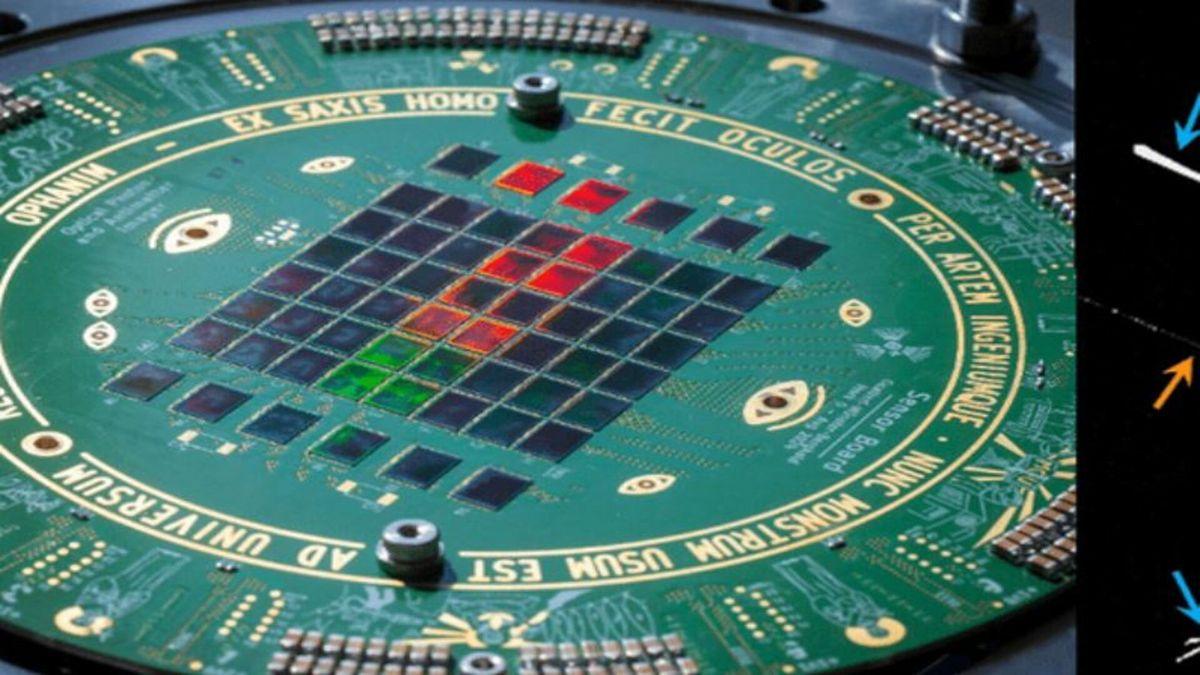
- Ophanim combines daily technology with high -end scientific imaging capacity
- Antimatter detection is now possible using reused smartphone camera technology
- The Gigapixel device could instantly reveal the fine details of particle collisions
At the CERN Antimatière factory, AEGIS collaboration explores a new approach to detect one of the rarest phenomena of nature: antiproton annihilation.
eenews Report that the team, led by Professor Christoph Hugenschmidt of the Munich Technical University (TUM), developed an experimental detector using sensors originally designed for mobile phone cameras.
Instead of creating a new sensor system from scratch, the researchers have reused mobile cameras of sixty 64 megapixels to form a network of 3.84 gigapixels called Ophanim, abbreviation of optical and antimatter photon. This composite detector can observe where antiprotons collide with matter, destroying in a flash of energy.
Mobile phones for antimatter research
“For AEGIS to work, we need a detector with incredibly high spatial resolution, and mobile camera sensors have smaller than 1 micrometer,” explains Francesco Guatieri, principal researcher at TUM.
To adapt the sensors for scientific use, the team had to use intensive micro-engineering to remove the camera sensors from the diapers intended for mobile telephony electronics.
“We had to eliminate the first layers of the sensors, which are designed to deal with the advanced integrated electronics of mobile phones,” explains Guatieri. This process has enabled sensors to directly capture light models associated with annihilation events.
Despite their origins, mobile sensors do not compromise performance. In fact, the new detector offers an improvement of 35 times in real -time resolution compared to previous methods.
“Previously, photographic plates were the only option, but they lacked real -time capacities,” added Guatieri.
“Our solution, demonstrated for antiprotons and directly applicable to antihydrogen, combines resolution in the photographic plate, real-time diagnostics, self-establishing and a good particle collection area, all in a single device.”
The ophanim detector allows researchers to observe real -time annihilation events with a resolution of approximately 0.6 micrometer, thin enough to distinguish the different particles created during the process.
“This is a technology that changes the situation for the observation of the tiny changes due to gravity in an antihydrogen beam traveling horizontally, and it can also find wider applications in experiences where a high position resolution is crucial or to develop high-resolution trackers,” said the spokesperson for Aegis, Dr. Ruggero Caravita.
“This extraordinary resolution also allows us to distinguish between different fragments of annihilation, opening the way to new research on anti -app for low energy in materials.”
The implications of this work extend beyond research on the antimatter. Ophanim’s ability to follow particles with such precision could benefit a wide range of experiences, while offering a low -cost model built from existing consumption technology.


