
- Nvidia donates one of its most advanced AI supercomputers to the US military’s flagship university
- The supercomputer will be used in a range of applications, from simulations and digital twins, to weather forecasting and cybersecurity.
- “AI will be the backbone of America’s defense,” Nvidia CEO Jensen Huang said during the supercomputer’s commissioning.
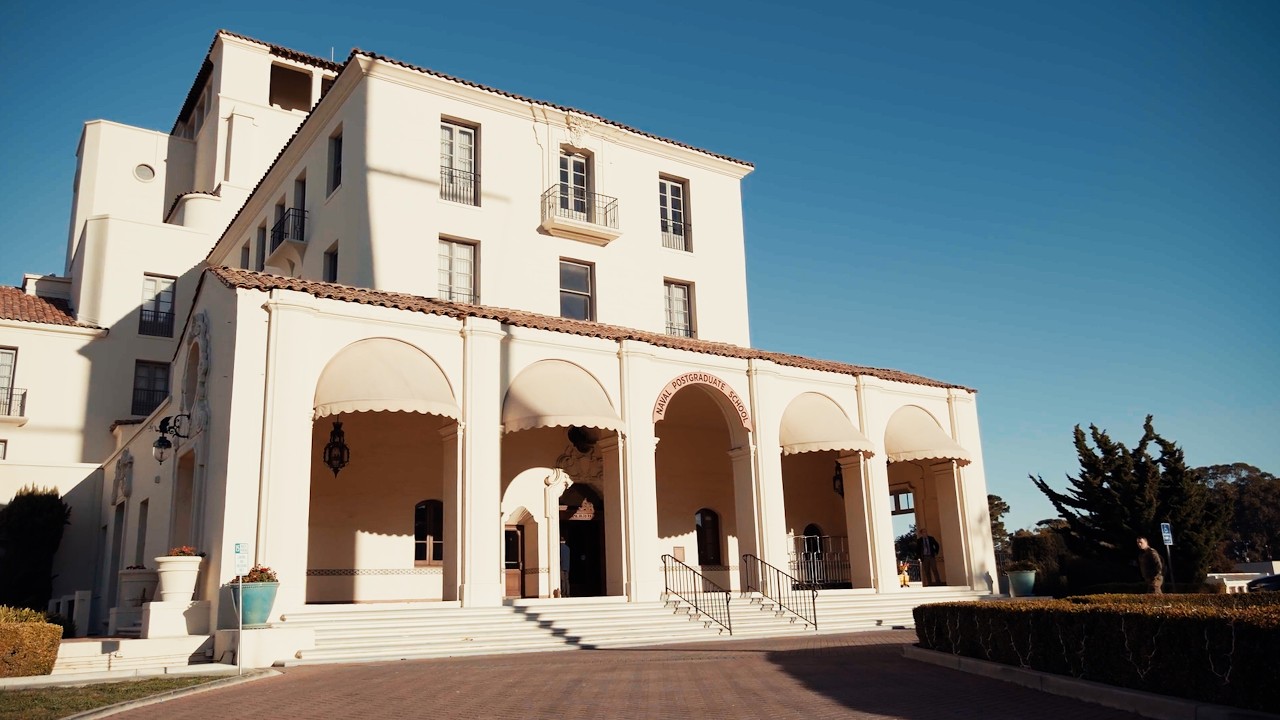
Nvidia has donated a DGX GB300 AI supercomputer to the Naval Postgraduate School in Monterey, California, to support students, researchers and faculty in the areas of weather forecasting, cybersecurity, disaster resilience and response planning.
The supercomputer was put into operation in the presence of Nvidia CEO Jensen Huang. “Our nation depends on our men and women fighting on the front lines,” Huang said.
“Nothing is more valuable to you than information and insight, and timely information and insight, and understanding their impact and their consequences. I can’t imagine anything more important.”

An AI supercomputer for training, ocean modeling and digital twins
The Nvidia DGX GB300 is one of Nvidia’s most powerful AI servers and hosts 72 Nvidia Blackwell Ultra GPUs, along with 36 Nvidia Grace processors, which provide 20 TB of GPU memory at a bandwidth speed of up to 576 TB/s.
This will provide the U.S. Army’s flagship university with increased capacity to train new leaders in AI, and enable more technical applications through internal foundational models, run simulations, and use digital twins to train students from all branches of the military in real-world navigation and decision-making.
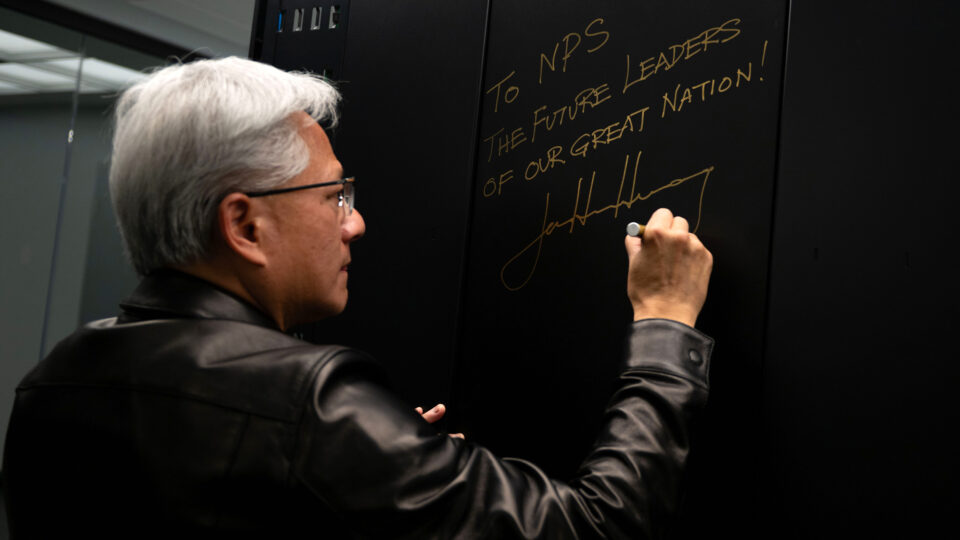
“Leadership is about being of service to something else. You are of service to your team. You are of service to your country. You are of service to your mission,” Huang said during the commissioning. “And all this technology is just tools to help you.”
Adm. Samuel Paparo, commander of U.S. Pacific Command, said, “As we modernize our technology, we must also modernize how we train our leaders. Access to advanced computing capabilities means that NPS students and faculty understand the opportunities and responsibilities that come with these technologies.”
Look on it
The AI supercomputer will also allow students to better understand sea conditions and predict atmospheric changes, while equipping them for an increasingly AI-enhanced military.
The United States and China are competing fiercely to deploy increasingly capable AI models, with China quickly catching up despite widespread sanctions on the sale of AI chips to the country. Both countries are integrating AI systems into military, police and government agencies.
“Many of you will command in AI-enabled environments. Information will flow at lightning speed, reducing response times,” Paparo said. “Our advantage will come from leaders, like you, who can use technology to see, understand, decide and act faster while exercising the judgment, experience and leadership that machines cannot provide. This education is happening here at NPS.”

Follow TechRadar on Google News And add us as your favorite source to get our news, reviews and expert opinions in your feeds.


