
Pakistani cyber ‘Shaheens’ destroyed enemy’s cyber security, inflicting humiliating defeat on Indian Air Force
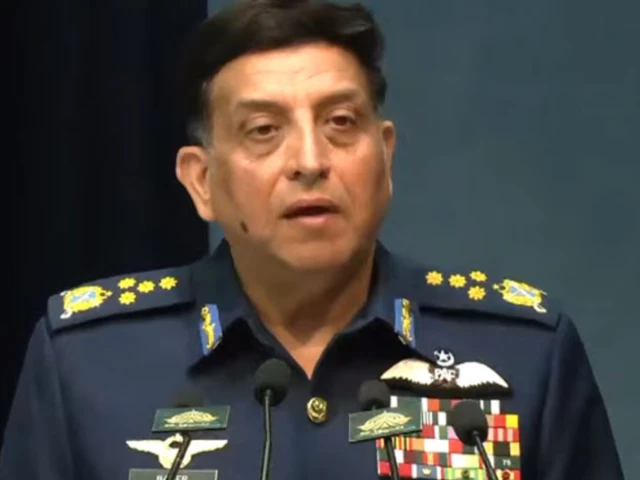
Air Marshal Zaheer Ahmed Baber Sidhu addressing a ceremony to mark the completion of one year of Marka-e-Haq at Air Headquarters Islamabad. PHOTO: RADIOPAK
Chief of Air Staff Marshal Zaheer Ahmed Baber Sidhu on Thursday said that the Pakistan Air Force (PAF) demonstrated its capability, resilience and dominance at Marka-e-Haq, confirming an unrivaled glorious legacy, Radio Pakistan reported.
The term “Marka-e-Haq” refers to the 2025 conflict with India, which began with the Pahalgam attack on April 22 and concluded with a ceasefire on May 10 following Operation Bunyanum Marsoos.
Addressing a ceremony to mark the completion of one year of Marka-e-Haq at the Air Headquarters in Islamabad, the Air Force Chief said that Pakistan’s resounding success was the result of a unified approach of all elements of national power and the blessings of God Almighty.
He mentioned that the PAF conducted a full spectrum multi-domain operation for the first time in the history of air warfare. He said the world was stunned to witness this superb execution of the PAF operation, perfectly choreographed and perfectly executed, adding that the PAF attacked many high value and high visibility targets.
پاکستان کے سائبرشاہینوں نے دشمن کی سائبرسکیورٹی کو تباہ کردیا۔بھارتی فضائیہ کو بھی عبرتناک شکست دیتے ہوئے دنیا کے سرفہرست لڑاکاطیاروں کو خاک میں ملادیا۔
معرکہ حق کی کامیابی کا ایک سال مکمل ہونے پر ایئر ہیڈکوارٹرز اسلام آباد میں تقریب سے خطاب کرتے ہوئے ایئرچیف مارشل… pic.twitter.com/AHVh7zWuE9– PTV News (@PTVNewsOfficial) May 7, 2026
The air chief said that Pakistan’s cyber Shaheen destroyed the enemy’s cyber security and while inflicting a humiliating defeat on the Indian Air Force (IAF), downed some of the world’s best fighter jets, the state television channel reported. PTV reported.
He said we had disrupted the enemy’s power and transportation system, crippled its critical operational installations, shot down most of the modern Rafale jets and destroyed a state-of-the-art S-400 battery. He said the enemy was literally on its knees long before we could imagine.
Read: Ishaq Dar calls Marka-e-Haq a symbol of national unity and courage
The Air Chief said that at the heart of this success was the Pakistan Air Force’s local kill chain, which seamlessly integrated all our operational elements into one formidable force package. Sidhu said the PAF could have gone further, but “we showed responsibility and applied well-calibrated force.”
Looking ahead, the Air Chief said we remain particularly focused on intensive preparation for future challenges. He mentioned that a range of capabilities of the National Aerospace Science and Technology Park are developing at an unprecedented pace. He said a host of indigenous projects are in the pipeline and are being vigorously pursued.
He added that the exemplary leadership of Chief of Army Staff and Chief of Defense Force Field Marshal Syed Asim Munir played an important role in the victory and the country’s leadership made these successes possible.
He concluded that the PAF will always live up to the expectations of the brave and resilient people of Pakistan, assuring that the PAF will remain a symbol of pride for the nation.
Attack on Pahalgam and Marka-e-Haq
On April 22, 2025, the escalation between Pakistan and India began when an attack in Pahalgam killed 26 people. India immediately blamed Pakistan for the incident. However, Pakistan has categorically rejected Indian responsibility.
Learn more: Pak efforts maintain ceasefire
In response, India undertook a series of hostile actions the next day, April 23, 2025, including suspending the 65-year-old Indus Water Treaty (IWT), canceling visas for Pakistani citizens, closing the Wagah-Attari border post, ordering the Pakistan High Commission in New Delhi to close, and reducing diplomatic staff at each other’s embassies.
Tensions further escalated in the early hours of May 7, 2025, when missile strikes hit six towns in Punjab and Azad Jammu and Kashmir (AJK), destroying a mosque and killing dozens of civilians, including women, children and elderly people.
In a swift military response, Pakistani armed forces shot down Indian fighter jets, including three Rafales. The confrontation escalated again in the wee hours of May 10, 2025, when India targeted several Pakistani airbases with missile strikes. In retaliation, Pakistan launched Operation Bunyanum Marsoos, damaging Indian military installations including missile storage sites, airbases and other strategic targets.
On May 10, 2025, U.S. President Donald Trump announced that a ceasefire had been reached following intense diplomatic efforts overnight. Minutes later, the deal was separately confirmed by Pakistani Foreign Minister Ishaq Dar and Indian Foreign Minister.


