
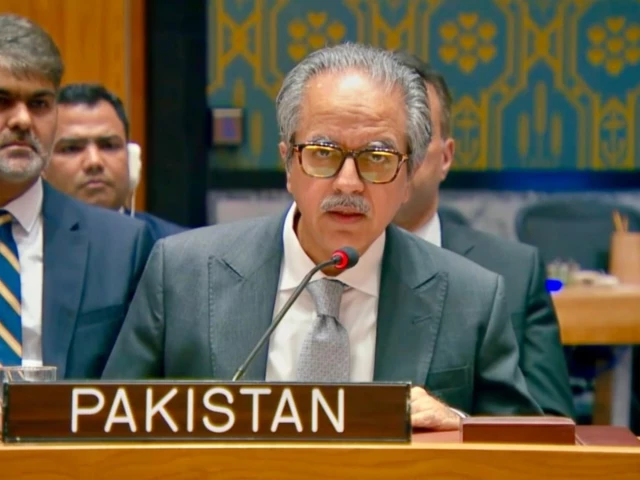
Pakistan’s Permanent Representative to the United Nations, Ambassador Asim Iftikhar Ahmad, addressing a UN Security Council briefing on non-proliferation. PHOTO:
Pakistan on Wednesday urged all parties to exercise restraint and give diplomacy “a little more chance” amid heightened tensions in the Middle East, warning that recent events have highlighted the risk of further escalation.
Addressing a UN Security Council briefing on non-proliferation, Pakistan’s Permanent Representative to the UN Ambassador Asim Iftikhar Ahmad said Islamabad was “deeply concerned” about the current situation in the region marked by heightened tensions.
“The events of recent days have amply underlined the fragility of the situation, the risk of escalation and the need for diplomatic efforts to bear fruit – as soon as possible,” he told the Council.
Statement by Ambassador Asim Iftikhar Ahmad,
Permanent Representative of Pakistan to the UN,
At the Security Council briefing on non-proliferation (1737 Committee)
(June 9, 2026)
*****President,
Pakistan is deeply concerned about the current situation in the region marked by… pic.twitter.com/f5vLN6I4PK
– Permanent Mission of Pakistan to the UN (@PakistanUN_NY) June 10, 2026
The ambassador said the recent increase in violence in the Middle East was “a stark reminder of the dangers associated with a tenuous ceasefire and the unbearable consequences it can bring.”
“The cycle of violence and instability must end for the sake of regional and international peace, security and prosperity,” he added.
Referring to the Iranian nuclear issue, Iftikhar said the latest hostilities had complicated diplomatic efforts and affected the work of the International Atomic Energy Agency (IAEA).
“Unfortunately, the breakdown in diplomacy and the outbreak of hostilities also had an impact on the consideration of the Iranian nuclear issue, further distancing the parties on this complex issue,” he said.
He added that the conflict had also “disrupted the IAEA’s crucial verification mandate.”
Reaffirming Pakistan’s position, the ambassador said Islamabad supports resolving all outstanding issues through dialogue and negotiations.
“We reaffirm our support for resolving all outstanding issues, including the Iranian nuclear issue, through peaceful means, diplomatic engagement and sustained dialogue,” he said.
Iftikhar said Pakistan believed that “diplomacy and dialogue should be the guiding principles” to achieve negotiated settlements of contentious issues.
Highlighting Pakistan’s diplomatic efforts, he said Islamabad had worked with international partners to help reduce tensions and encourage negotiations.
“Pakistan, with its partners, has launched diplomatic efforts to end the war and bring the parties to the table,” he said.
The ambassador added that Pakistan was engaged in efforts supporting “de-escalation, ceasefire and the broader pursuit of stability in the region.”
The Pakistani envoy also spoke about what he described as the “Islamabad talks”, saying Pakistan appreciated both sides for engaging in dialogue.
“We appreciate both sides for placing their trust in Pakistan, engaging in dialogue to achieve a ceasefire, and participating in the ‘Islamabad Talks’ – the highest-level direct engagement between the United States and Iran in over four decades,” he said.
According to the ambassador, Pakistan has maintained contacts with Tehran and Washington as well as with several regional and international partners.
He said Islamabad seeks to encourage dialogue, facilitate the exchange of messages and help create space and conditions for meaningful negotiations.
Iftikhar said Pakistan’s efforts were aimed at “breaking the momentum of hostilities, saving lives and giving diplomacy a chance.”
He described Pakistan’s approach as reflecting a “steadfast commitment to regional stability and international peace” and a preference for “principled and dialogue-oriented diplomacy” in dealing with geopolitical disputes.
Concluding his speech, the ambassador urged all parties to avoid any action that could undermine ongoing diplomatic efforts.
Read: Trump says US ‘must respond’ after Iran shoots down ‘highly sophisticated Apache helicopter’
“As we work seriously and painstakingly, with our friends and partners, to find a peaceful diplomatic solution to the conflict, and especially as the final goal is about to be achieved, we sincerely urge all parties to exercise restraint and give peace a little more chance,” he said.
He added: “Let us continue to follow the path of peace and diplomacy, because it offers great prospects for success, on which the international community has placed its hopes.”
Iranian nuclear program
Five days ago, the U.N. nuclear watchdog sent a report to member states with no major changes in its assessment of Iran’s nuclear program, despite three months of U.S.-Israeli war with the stated aim of stopping Iran from building an atomic bomb.
In its first report on Iran’s nuclear program since the day before US and Israeli airstrikes on Iran in late February, the IAEA reiterated its calls for Tehran to explain the fate of enriched uranium stockpiles. Uranium has disappeared since a previous US-Israeli bombing campaign a year ago targeted Iran’s main nuclear sites.
US President Donald Trump and Israeli Prime Minister Benjamin Netanyahu repeatedly cited the destruction of Iran’s nuclear program as one of their main goals when they launched new strikes in late February.
Iran’s stockpile of enriched uranium has been a major sticking point in negotiations between the United States and Iran to end the war, with Trump insisting that Iran give it up. Efforts have recently focused on a preliminary deal that would leave nuclear issues for later.
The confidential report on Iran was one of two released on June 5 and viewed by Reuters ahead of next week’s quarterly meeting of the Board of Governors of the International Atomic Energy Agency, which brings together 35 countries. They showed very little change from previous reports from late February, just before the last war.
“The Director General (of the IAEA) stressed to Iran that it is essential and urgent to effectively implement the NPT (Non-Proliferation Treaty) safeguards agreement… and that its implementation cannot under any circumstances be suspended by Iran,” the report reads. Reuters said.
The IAEA was unable to return to the nuclear sites bombed by Israel and the United States last June. Iran has not yet informed the IAEA of the fate of its stockpiles of low- and highly-enriched uranium (LEU and HEU), including uranium enriched up to 60% purity, a step closer to the approximately 90% weapons-grade level.
The region has been under tension since the United States and Israel launched airstrikes against Iran in late February, triggering Iranian retaliation against Israel and other regional countries harboring U.S. assets.
A temporary ceasefire was agreed on April 8, but negotiations subsequently stalled due to disputes over its implementation and subsequent regional developments, even as Trump extended the truce indefinitely.
A deal to completely end the US-Israeli war with Iran has proven elusive, with Iran insisting that any negotiations over its nuclear program would take place after the war has completely ended.


