
WHO says Pakistan managed to reduce tobacco consumption by 15.7% between 2014 and 2024
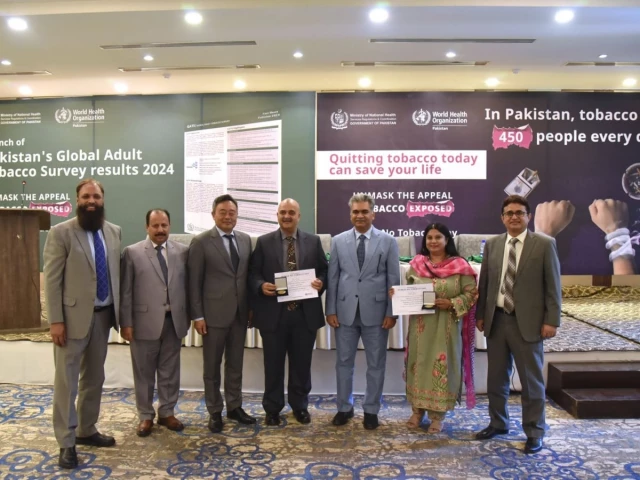
The World Health Organization (WHO) has conferred the World No Tobacco Day (WNTD) 2026 award on Pakistan in recognition of its outstanding contributions to tobacco control.
According to the statement released by WHO, the award was jointly awarded to the Tobacco Control Cell of Pakistan’s Ministry of National Health Services, Regulation and Coordination and Dr. Waseem Iftikhar Janjua, Senior Researcher at the Sustainable Development Policy Institute (SDPI).
The WNTD Award is presented annually to individuals or organizations from each of the six WHO regions in recognition of their outstanding contributions to tobacco control.
The statement further added that Pakistan successfully reduced its tobacco consumption by 15.7 per cent between 2014 and 2024, thanks to measures implemented to fulfill its international obligations under the WHO Framework Convention on Tobacco Control (FCTC), according to new results of the Global Adult Tobacco Survey (GATS) 2024 conducted by the Government of Pakistan in partnership with WHO and CDC Foundation.
Learn how Pakistan has reduced tobacco consumption and saved lives over the past 10 years through measures such as taxation under the @WHO Framework Convention on Tobacco Control.
Together, we can protect our families and our children from tobacco. pic.twitter.com/VfYN4rO4gZ– WHO Pakistan (@WHOPakistan) June 3, 2026
“Tobacco products are still consumed by 16.1% of Pakistan’s population aged 15 and above. As a result, each year, tobacco continues to cause nearly 164,000 deaths and economic losses of over 1.8 trillion Pakistani rupees (approximately $6.6 billion).”
He said the GATS 2024 results were presented – under the leadership of Minister of Health Mustafa Kamal – as part of the extended WTD celebrations and the international campaign launched by WHO under the theme “Unmasking the Call – Fighting Tobacco and Nicotine Addiction”.
Learn more: The president commits to protecting young people from the harm of tobacco
The survey followed a global standard science-based protocol to systematically monitor tobacco use among adults, providing trends over the past decade and a comparison with the 2014 cycle.
It was carried out by the National Institute of Population Studies, Training and Research in collaboration with the Ministry of National Health Services, Regulation and Coordination – through its tobacco control unit – and the WHO. More than 11,000 interviews were completed with an overall response rate of 95.6%.
Reduced exposure to second-hand smoke
Among other encouraging key findings, the GATS 2024 results highlight that – between the previous survey in 2014 and 2024 – exposure to second-hand tobacco smoke in Pakistan decreased in all locations measured in both surveys: homes (48.3% to 28.8%), workplaces (69.1% to 35.9%), government buildings (64.6% to 40.7%), private buildings (77.3% to 54.8%), health establishments. (37.6% to 24.5%), restaurants (86.0% to 55.2%), wedding halls (65.7% to 50.3%), public transport (76.2% to 45.4%), universities (44.2% to 33.3%) and schools (25.1% to 11.5%).
Additionally, the survey reported a decrease in exposure to tobacco advertising or promotions in stores (from 20.4% to 17.8%) and any tobacco advertising, promotion or sponsorship (from 38.6% in 2014 to 30.5%).
However, women’s tobacco use increased slightly by 1.7%, with 5.9% of women aged 15 and older smoking, and there was a slight decrease in the percentage of smokers who attempted to quit in the past 12 months (from 24.7% to 24.1%) and who were advised to quit during a visit to a health care provider (from 51.8% to 49.9%).
Main anti-smoking measures to prevent major health risks
The findings further add that since 2014, under the auspices of the WHO FCTC, Pakistan has implemented key policy changes to reduce tobacco consumption, including a 208% increase in tobacco taxation in the 2022-2023 financial year; larger pictorial health warnings on tobacco product packaging; a nationwide ban on the sale of loose cigarettes; the National Tobacco Control Strategy 2022-2030; and the creation of provincial tobacco control units and implementation and monitoring committees, among others.
Secretary of the Ministry of National Health Regulation, Services and Coordination, Muhammad Aslam Ghauri, addressing the event, said that “the theme of this year’s WNTD, ‘Unmasking the Call – Fighting Tobacco and Nicotine Addiction’, served as a timely reminder of the evolving tactics employed by the tobacco and nicotine industries to target young populations and create lifelong addiction.
Read also: The rise of vapes and electronic cigarettes fuels new nicotine risks for Pakistani youth
“The emergence of e-cigarettes, vaping devices, heated tobacco products and digital advertising platforms has transformed the tobacco epidemic into a more complex public health challenge. The aggressive targeting of young people through flavored products, the influence of social media and misleading perceptions about safer alternatives require urgent and coordinated policy action,” he said.
Pakistan’s tobacco control measures reduced consumption by 15.7% over 10 years.
The Global Adult Tobacco Survey 2024 confirms the positive impact of Pakistan’s policies under the WHO Framework Convention on Tobacco Control.
Together we can save lives.#WorldNoTobaccoDay pic.twitter.com/u336XC5LHP– WHO Pakistan (@WHOPakistan) June 3, 2026
Ghauri recalled that Pakistan still faces a significant tobacco-related burden. “Findings from the GATS Pakistan 2024 study reveal that approximately 22.7 million adults currently use tobacco products in the country. Exposure to second-hand smoke and tobacco advertising remains prevalent, particularly in public spaces and among younger age groups. Approximately 163,600 Pakistanis die from tobacco-related causes each year, accounting for 448 deaths per day.”
WHO Representative in Pakistan, Dr Luo Dapeng, said: “The GATS 2024 results confirm that together we can protect and save lives through international cooperation and the implementation of specific measures such as taxation and banning tobacco advertising, which particularly target our children and adolescents.
“The science is very clear: all tobacco products are deadly. WHO will always stand with Pakistan to protect our children and families from this public health threat,” he added.


