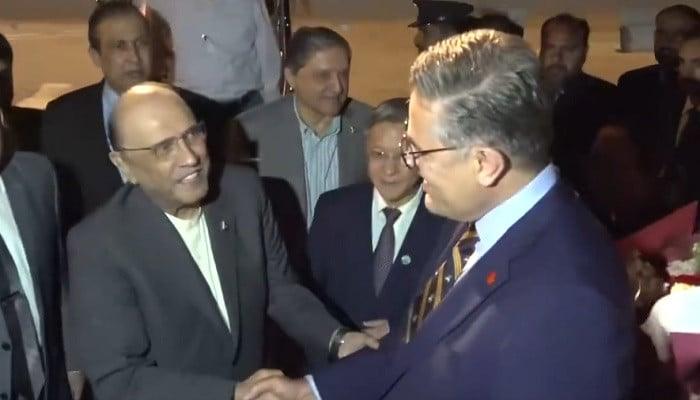
- The trip focuses on economic cooperation and collaboration in the corridors.
- Hu Xusheng, head of Hunan, receives the president in Changsha.
- Envoys from both countries, senior officials present on arrival.
President Asif Ali Zardari landed in China shortly after midnight on Saturday, beginning an official visit focused on strengthening economic and trade ties, with a focus on the China-Pakistan Economic Corridor (CPEC).
According to a statement from his office, he arrived in Changsha and was received by Hu Xusheng, vice chairman of the Standing Committee of the Hunan Provincial People’s Congress.
“[The] Ambassadors of China to Pakistan and Pakistan to China were also present on the occasion,” the President’s Secretariat said.
Punjab Governor Sardar Saleem Haider bid farewell to the president at the Allama Iqbal International Airport, according to state broadcaster Pakistan Television Corporation.
The Foreign Ministry said in a statement that the president is expected to visit Changsha, Hunan province, from April 25 to 27, and then to Sanya, Hainan province, from April 28 to May 1.
“During the visit, the President will hold meetings with provincial leaders to review the overall relationship between Pakistan and China, with special emphasis on economic and trade cooperation as well as the China-Pakistan Economic Corridor (CPEC),” the statement added.
According to FO, the visit is part of the “long tradition of high-level exchanges between Pakistan and China and bears special significance as the two countries celebrate the 75th anniversary of the establishment of diplomatic relations this year.”
He further noted that the trip reflects the “deep commitment” of both sides to further strengthen the strategic cooperative partnership.
Last year, President Zardari visited China for a 10-day official visit, during which he met with senior Chinese leaders to deepen bilateral relations, expand cross-sector cooperation and advance common priorities.
Six MoUs have been signed between the Sindh government and business partners, covering agriculture, defence, energy, rail connectivity and farmer training, with plans to expand these initiatives to other provinces.