
Muzaffarabad Deputy Commissioner confirms Mir’s arrest in joint operation in Dhirkot
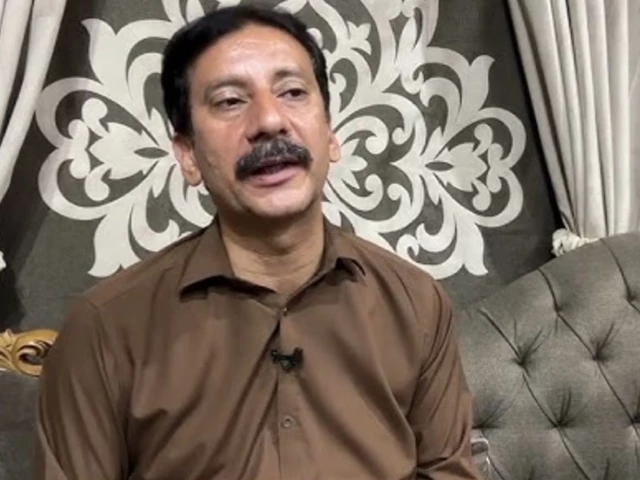
Chief of banned Jammu Kashmir Joint Awami Action Committee (JAAC), Shaukat Nawaz Mir. SCREENSHOT/ Youtube
Shaukat Nawaz Mir, leader of the recently banned Jammu and Kashmir Joint Awami Action Committee (JAAC), was arrested on Tuesday from Dhirkot area of Azad Jammu and Kashmir, an official said.
The situation in AJK remains tense after the government banned the JAAC, with the group continuing its sit-in and vowing to support the protest until its “legitimate demands” are met.
Muzaffarabad Deputy Commissioner (DC) Munir Qureshi confirmed Mir’s detention while speaking to The Express PK Press Club.
Read: TTAP says police arrested AJK-bound delegation
DC Qureshi said Mir was arrested from Dhirkot in a joint operation carried out by the district administration and police based on intelligence inputs.
Following the arrest, the JAAC also confirmed Mir’s detention in a statement, saying his colleague Saib Javed had also been arrested. He describes them as activists for “people’s rights, justice and a better future”.
The group claimed Mir was arrested while trying to reach an ongoing sit-in, saying a search operation involving intelligence agencies, police and other institutions led to his detention before he could join the protest.
In a separate statement, the JAAC said Mir’s presence at the sit-in would have significantly boosted the morale of participants, but insisted that the arrest of a single leader would not weaken the movement.
“A voice can be suppressed, but not resolved. A person can be arrested, but not the movement,” he adds.
The JAAC said Mir was not alone and asserted that the entire nation stood with him, expressing confidence that “victory will be for justice”.
Urging its supporters not to be discouraged, the group said public movements did not depend on a single individual.
Also read: AJK govt rules out blanket amnesty for JAAC
“This is not just about Shaukat Nawaz Mir’s movement, nor just about his core members. It is about the movement of the entire public,” the statement said.
The JAAC added that arrests, searches, imprisonments and sacrifices were historically part of public movements, expressing confidence in Mir’s soon return to the people.
Until then, he said, the public will remain “his voice” and continue his mission, adding that the movement will emerge stronger despite the arrest and that “in the end, victory will belong to the people and defeat to tyranny, arrogance and the system of exploitation.”
Background
The recent unrest and deadly clashes broke out in certain areas, notably in Rawalakot, where the JAAC had organized a sit-in in front of the Rawalakot Combined Military Hospital. AJK police say armed JAAC members opened fire on security forces deployed during a planned attack, leaving four people dead and around 20 injured. The JAAC, however, disputes this version, saying that security forces used tear gas and fired shells towards the hospital.
According to the AJK Police, three individuals linked to the JAAC and four law enforcement personnel were killed during the protests. The JAAC, however, said in a statement on
The clash occurred as the AJK government and JAAC witnessed a face-off with the election date for AJK being announced for July 27.
Learn more: Some elements seeking to create instability within AJK despite repeated offers for dialogue: Rana Sanaullah
The 53-member AJK Legislative Assembly has 12 seats reserved for Kashmiri refugees, people who fled Indian-controlled Kashmir in 1947 and 1965 and are now scattered across Pakistan. Six seats represent refugees from the Jammu division (~434,000 people) and six from the Kashmir Valley (~30,000 people) – an already lopsided arrangement that many see as unfair.
The region experienced one of its most turbulent periods in October last year, when JAAC-led protests erupted demanding constitutional and governance reforms. At least nine people, including three police officers, were killed during the unrest.
The JAAC, which organized the protests and strike, had presented a broad charter of demands, including an end to the privileges enjoyed by the ruling elite, the removal of 12 assembly seats reserved for refugees and the abolition of the quota system.
Two days after the violence, the government and the JAAC reached an agreement on 12 basic points and 13 additional points. Under the agreement, both sides agreed to constitute a high-level committee to look into the issue of refugee seats in the AJK Legislative Assembly.


