
THE UNITED NATIONS:
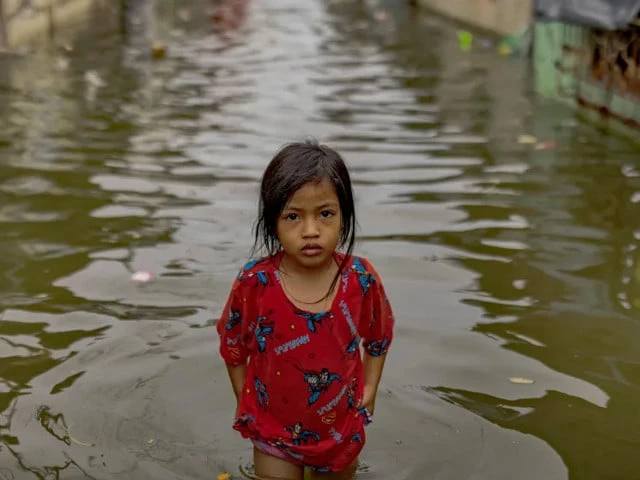
More than a billion children face at least three overlapping climate hazards, including 34 million in Pakistan, UNICEF warned on Monday, while highlighting the disproportionate impact in some regions of the world.
For the report, the UN agency cross-referenced data showing where the planet’s estimated 2.4 billion children live with the geographic distribution of the eight most common climate impacts. These include coastal flooding, river flooding, droughts, tropical storms, heat waves – at least three days above a high temperature threshold, which varies by country – extreme heat, forest fires and sandstorms.
The report focuses primarily on the 1.1 billion children who are exposed to at least three risks, with the most common combination being drought, extreme heat (above 35 degrees Celsius) and heat waves.
This combination affects some 296 million children, including 74 million in Nigeria, 34 million in Pakistan and 32 million in India.
The number of children in this category of three or more has increased sharply over the past 20 years.
Almost all children – some 2.3 billion – are exposed to at least one risk. Two billion are exposed to at least two, while 364 million are exposed to at least four.
Of the 123,000 children exposed to seven or more climate hazards, around 46,000 are in Myanmar.
“Children are on the front lines of the impact of climate change,” said UNICEF Director Catherine Russell.
As for the worst place for a child, “there is no very short answer,” one of the report’s authors, Tom Slaymaker, told AFP.
“Hot spots”
“But they’re not all equal,” Slaymaker said. “We’re seeing some hot spots…it’s really concentrated in sub-Saharan Africa and parts of South Asia.”
Countries with large populations of children, including Bangladesh, India, Nigeria and Pakistan, top the list for the number of children exposed to three or more hazards.
But in percentage terms, countries in sub-Saharan Africa – particularly the Sahel – have the largest proportion of children affected by hazards. The impacts are often exacerbated by the inability of governments to deal with climatic hazards.
Chad, for example, faces a humanitarian crisis with limited access to water, electricity and food. According to the report, more than 95 percent of the country’s children are exposed to at least three hazards, one of the highest proportions in the world.
Other particularly vulnerable countries include 39 island states that face challenges such as limited access to fresh water, dependence on imports and the inability to easily shelter elsewhere after a disaster such as a hurricane.
No country is truly spared, the report shows.


