
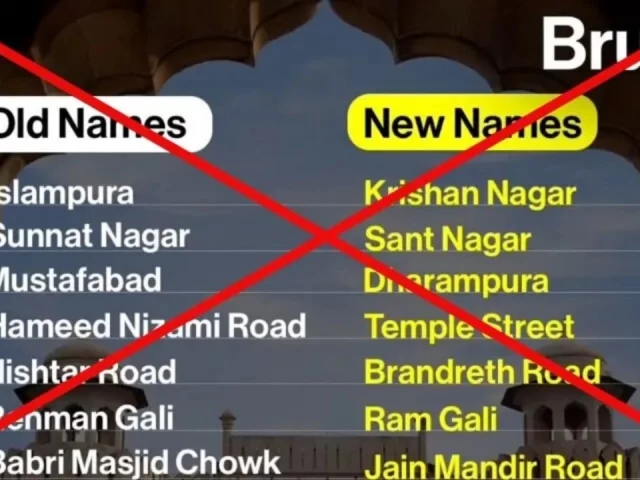
The claim that Lahore restored pre-partition street names is misleading. PHOTO: SCREENSHOT OF NEWS OUTLET
Since May 19, 2026, several Indian mainstream and digital media outlets have published reports claiming that the Punjab government was restoring pre-partition street names in Lahore. However, these reports are false and no such decision has been made yet.
How it started
On May 19, a major Indian media, India today, posted a video on YouTube, with the following title: “Pakistan restores Hindu and Sikh names to streets in pre-partition Lahore amid minority concerns.”
The post has been viewed 20,310 times.
In the video, the anchor can be heard saying, “We are receiving breaking news from Pakistan. Pakistan has restored the street names of pre-partition Lahore. Lahore is getting back Hindu and Sikh street names. So, Islampura in Pakistan is now Krishna Nagar; rise of Hindu persecutions, Pakistan has now restored the names from the pre-partition era.
She added that although restoration measures have been taken, “real actions are still awaited with regard to minorities.”
The same media outlet also published a report with the following headline: “Pak restores pre-partition Lahore street names: Islampura is now Krishan Nagar.”
He cited an unnamed Punjab government official as his source.
India today in the world also posted a video on YouTube with the title: “Pak restores Hindu, Sikh and colonial era names to Lahore as Nawaz Sharif revives pre-partition glory”.
The video report alleged that Pakistan had officially started restoring several historical Hindu, Sikh and colonial-era names in Lahore as part of a massive heritage revival campaign led by PML-N President Nawaz Sharif and Punjab Chief Minister Maryam Nawaz.
The clip’s description reads: “The renaming effort is part of the Lahore Authority for Heritage Revival or LAHR, a 50 billion rupee urban conservation initiative aimed at restoring Lahore’s multicultural identity and architectural heritage. The authorities are also restoring temples, churches, gurdwaras and colonial-era buildings linked to Sikh leader Maharaja Ranjit Singh and Princess Bamba Sutherland.”
The Indian Express also published a report with the following headline: “Pakistani Punjab government to restore names of pre-partition streets of Lahore.”
According to the report, the Punjab government has approved a plan to restore the names of several streets and roads in Lahore, in a bid to revive the city’s pre-partition heritage.
The report did not cite any credible sources or provide images of the streets that should be renamed.
NDTV also published a report with the following title: “Rehman Gali becomes Ram Gali: Why Pak is changing the names of streets in Lahore. »
The report said that the official signs in Islampura pointed to Krishan Nagar, Babri Masjid Chowk had reverted to Jain Mandir Chowk and Rehman Gali had reverted to Ram Gali.
A local Indian magazine, Outlook Indiaalso shared a post on Instagram with the following caption: “Lahore restores pre-partition street names across the city. Rehman Gali is now Ram Gali again. Islampura has returned to Krishan Nagar. Babri Masjid Chowk is now Jain Mandir Chowk. At least nine places have already been renamed, with more changes planned as part of the Lahore Heritage Zone Revival Project. The government describes it as an effort to restore the heritage Critics argue that it also serves a broader diplomatic and political economic objective amid IMF reliance, FATF scrutiny, and efforts to attract foreign investment and tourism.
In the same way, Raw Indiaa digital media outlet, shared a list on its Facebook account showcasing the old and new street names of Lahore. “The Pakistani Punjab government has approved the restoration of historic Hindu, Sikh and Jain street names in Lahore as part of the ‘Lahore Heritage Areas Revival Project’, aimed at preserving the city’s multicultural history,” the caption reads.
Methodology
A fact check was launched to determine the veracity of this claim due to the massive Indian media coverage on the matter and strong public interest in the subject.
A keyword search was conducted to check whether any Pakistani media had recently reported that Lahore was officially restoring pre-partition street names, but no such reports were found.
Several government officials and authorities have been contacted to corroborate this matter.
Hafsa Javed Khawaja, communications specialist at the Directorate General of Public Relations Punjab (DGPR), denied the claim, calling it “fake news”. Noukta Murtaza Dar, editor-in-chief from Lahore.
Similarly, Deputy Commissioner of Lahore, Captain (R) Muhammad Ali Ejaz told The Express PK Press Club (ET) correspondent Afzal Talib that none of the street names in Lahore had been changed, adding that the information circulating online was false.
Shahid Kathia, managing director of the Metropolitan Corporation of Lahore, also denied the Talibs’ allegations, stating that the circulating reports had no authenticity and no official name change of streets in Lahore had taken place.
Additionally, Tania Qureshi, spokesperson for the Walled City Authority of Lahore, was also contacted regarding the matter. She said AND Correspondent Asif Mehmood that although discussions regarding this have taken place, no official notification to this effect has been issued by the relevant authorities in this regard.
None of the Indian media reports reporting this claim provided an official government notification or corresponding document as confirmation. The reports also do not cite a named government official or present photos of the newly named streets, raising doubts about the authenticity of this claim.
A keyword search yielded two AND reports from March 20 and April 6, 2026, entitled respectively: “Historical names of streets to be restored” and “Government considers restoration of monument names”, respectively.
The former said a decision to revive the original names of historic roads, streets and government colleges of Lahore was approved in a meeting chaired by CM Maryam and Nawaz to restore the historical identity and cultural heritage of the city.
The second report stated that the Punjab government had announced a comprehensive plan to restore the original names of historic areas, roads and monuments in Lahore to highlight the city’s historical identity and strengthen its connection with cultural heritage.
He added that in the past several places were renamed, such as Krishan Nagar to Islampura, Dharampura to Mustafabad and Ram Gali to Rehman Gali. Similarly, Mall Road was renamed to Shahrah-e-Quaid-e-Azam, Mohan Lal Bazaar to Urdu Bazaar, Abbott Road to Ghaznavi Road, Lahore Stadium to Gaddafi Stadium, Gol Bagh to Nasir Bagh and Minto Park to Iqbal Park.
“However, many of these new names have not been fully accepted by the public. Officials say these changes have partially blurred the historical identity of the city. Under the proposed plan, the original names will be reintroduced to reconnect citizens with their past and revive the cultural character of Lahore,” the report added.
Kamran Lashari, secretary of the Lahore Heritage Revival Authority, said the city’s streets, markets and roads were an integral part of its cultural history and restoring their original names would promote historical awareness.
“Despite changes in official names, many old names continued to be used by the public, indicating that historical identity persists,” he said.
For further investigation, a team from Nukta provided iVerify with photos of major street signs in Lahore, which show that both old and new names are still used in the city, with the latter not restored to the former.
As can be seen in this photograph, the Dharampura and Mustafabad signs are installed in several places in Lahore, contrary to Indian media claims that Mustafabad had been returned to Dharampura.
Similarly, the Abbott Road and Ghaznavi Road signs were installed across Lahore in official institutions: the Metropolitan Corporation and the DGPR. Abbott Road had been renamed Ghaznavi Road.

Lakshmi Chowk was renamed Maulana Zafar Ali Khan Chowk, but signage for both was installed.

Lawrence Road was renamed Bagh-i-Jinnah Road, but signs for both are currently used by official institutions: the Punjab Transport Company and the Walled City Authority of Lahore.

The continued use of the new names in the panels shows that they have not been restored to their pre-partition names.
However, as noted above by Lashari and as shown in the photo, official signage and signs in Lahore continue to use a mixture of pre-partition names and their new names. Other examples of old names used are provided below.
Temple Road, which has been renamed Hameed Nizami Road, is still referred to on signboards by its original name.

The same goes for Jain Mandir Road, which has been renamed Babri Masjid Chowk. It is referred to by its original name on the signs.

Fact Check Status: Misleading
The claim that Lahore restored pre-partition street names is misleading.
Although this decision was deliberate, no formal action was taken to this effect. The new names continue to be used in official signage. Concerned government officials confirmed that no street has yet been officially restored from its new name to its pre-partition name.
This fact check was originally published by iVerify Pakistan — a project of CEJ-IBA and UNDP.


