
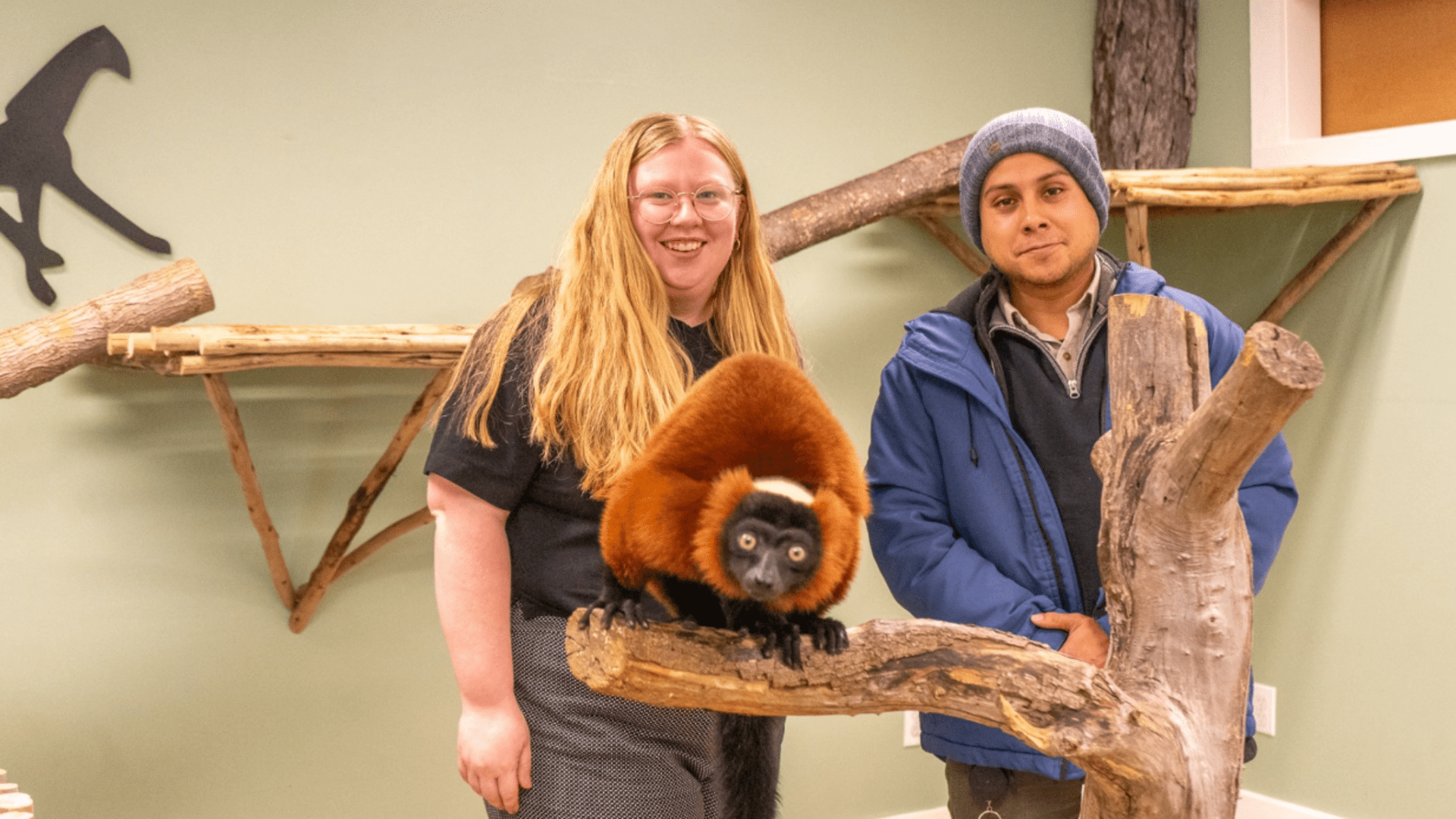
- Lemurs become more interested in technology when humans share control of interactive systems
- Zoo visitors stay longer when animals visibly respond to requests
- Shared control increased both the frequency of animal interactions and visitor attention
A research team from the University of Glasgow tested whether animals could interact with technology in a way that resembles experiences shared with humans.
Their system, known as CreatureConnect, allowed zoo visitors and collared lemurs to influence sounds, visuals and smells through linked interfaces placed on either side of an enclosure.
The principle was not direct communication, but a mediated interaction in which both species could affect the same environment.
Article continues below
Collared lemurs prefer to share control rather than act alone
During a 20-day trial at Blair Drummond Safari Park, more than 16,000 visitors passed through the exhibit, and 1,719 people actively used the system.
The lemurs interacted with the device 541 times, suggesting repeated engagement rather than accidental contact.
The system varied between automatic, human-only, lemur-only, and shared control modes, providing a structured comparison of behaviors between different interaction types.
The results indicate that lemurs were less involved when they had sole control of the system. Instead, they interacted more frequently when humans were also involved, suggesting a preference for shared control over isolated use.
“We were surprised to find that the lemurs don’t necessarily want to control the device alone. Instead, they seem to want to share,” said Jiaqi Wang, a doctoral student at the School of Computing Science at the University of Glasgow.
This contradicts initial expectations regarding the independence of animals in such contexts. The animals also displayed consistent preferences for the types of stimuli they activated.
High-intensity scents, bright visual patterns, and moderate sound levels triggered stronger responses, indicating that engagement was not random but linked to specific sensory conditions.
Human behavior changed noticeably when CreatureConnect was active, which was accompanied by an increase in visitors and longer stays in the enclosure.
“Using technology to foster high levels of engagement and empathy could help zoo visitors leave not only with happy memories, but also with a keener interest in wildlife conservation,” Wang added.
Visitors also reported greater enjoyment, greater empathy, and a stronger connection when they perceived the animals reacting to their comments.
“It’s fascinating to see how well visitors and lemurs collaborate with each other,” said Lorna Graham, research coordinator at Blair Drummond Safari Park.
“When people can see the lemurs react and make their own choices, something really seems to click. That shared moment creates a real connection – and when you feel connected to an animal, you’re much more likely to care about its future.”
Researchers believe this form of mediated interaction could resolve a long-standing tension between animal welfare and visitor expectations.
If similar responses can be observed in less familiar species, the approach could influence how public interest in conservation develops.
“Research like this helps us better understand what our animals value, while developing deeper empathy between humans and wildlife. This is incredibly powerful for the future of conservation,” Graham added.
Follow TechRadar on Google News And add us as your favorite source to get our news, reviews and expert opinions in your feeds. Make sure to click the Follow button!
And of course you can too follow TechRadar on TikTok for news, reviews, unboxings in video form and receive regular updates from us on WhatsApp Also.


