
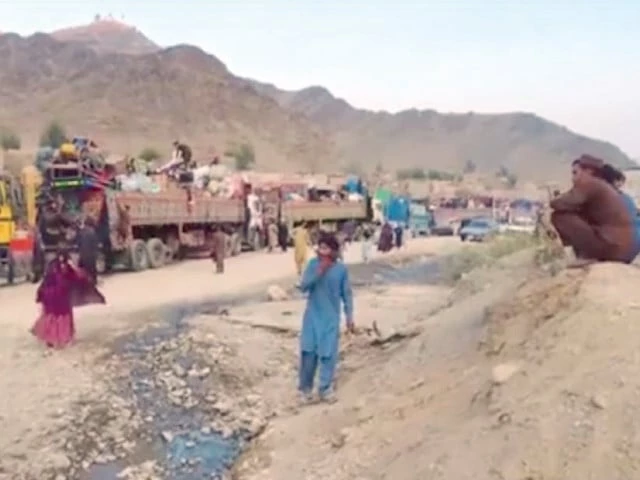
Hundreds of Pakistani drivers and drivers stranded in Afghanistan return home as Afghan repatriations accelerate
KHYBER:
Hundreds of Pakistani truck drivers and conductors stranded in Afghanistan for nearly nine months have finally started returning home, as authorities on both sides of the border continue to accelerate the repatriation of Afghan nationals from Pakistan.
These two events transformed the Torkham crossing into a scene of emotional reunion, administrative emergency and renewed debate on migration, trade and humanitarian responsibilities.
For Pakistani driver Humayun Shinwari, the moment he returned to Pakistan on Sunday marked the end of a painful chapter. Overwhelmed with emotion, he bowed down in gratitude as he returned home after months of uncertainty.
“We waited nine months,” Shinwari told reporters. “Our vehicles were parked for so long that they began to deteriorate. We had no proper facilities or relief. Many drivers were forced to sell or return their cargo just to survive.”
Shinwari is among nearly 600 Pakistani drivers and drivers stranded in Afghanistan after the Torkham border post was abruptly closed in September 2025 amid heightened tensions and security concerns.
The prolonged shutdown has disrupted cross-border trade, halted the movement of goods and passengers and left hundreds of transport workers stranded far from their families.
For many, the financial impact has been devastating.
Truck owners suffered heavy losses as their vehicles sat idle for months while drivers struggled to provide for their families back home. Local businesses in border areas, heavily dependent on commercial activities, have also faced serious economic setbacks.
The return of the stranded Pakistanis follows weeks of diplomatic engagement and coordination between Pakistani and Afghan authorities.
Jamiat Ulema-e-Islam-Fazl (JUI-F) district chief Maulana Ijaz Shinwari confirmed that the repatriation process had officially begun.
“The return of stranded Pakistani trucks, drivers and conductors is underway, and we hope that they will all return home soon,” he said. He noted that the border closure had led to significant losses in bilateral trade and negatively affected the regional economy.
“The suspension of border operations has not only impacted trade; it has also created a humanitarian crisis,” he said. “Poverty and unemployment have increased sharply in border communities, affecting thousands of families.”
According to local authorities, the immediate priority is to ensure the safe return of all stranded Pakistanis, after which authorities are expected to announce a roadmap for the gradual restoration of trade and border operations.
Torkham forms one of the most important trade corridors between Pakistan and Afghanistan, facilitating the movement of goods worth billions of dollars annually. Any disruption to operations at the border crossing impacts supply chains and local economies on both sides of the border.
As Pakistani transport workers celebrate their return, the border is simultaneously witnessing a significant increase in the movement of Afghan nationals returning to Afghanistan.
The Khyber-Pakhtunkhwa government has directed all relevant departments to expedite the repatriation process and complete the ongoing operations within the next 30-45 days.
Special Assistant to Chief Minister for Interior Tariq Saeed Marwat said temporary transit camps remain operational in Peshawar, Charsadda, Kohat and Hangu to facilitate the return of Afghan families.
“We have reviewed all outstanding issues related to visas and stay regarding Afghan citizens,” Marwat said. “The dignity, self-respect and basic rights of those who return will be protected throughout the process.”
According to the latest data jointly released by the United Nations High Commissioner for Refugees (UNHCR) and the International Organization for Migration (IOM), more than 2.5 million Afghan nationals returned to Afghanistan from Pakistan between September 15, 2023 and June 13, 2026.
The report said 2,500,712 Afghans returned during this period, including 1,912,939 people who left voluntarily or for other reasons, 334,929 people who returned under the UN voluntary repatriation program and 252,844 people who were expelled.
The pace of repatriations has accelerated considerably in recent weeks.
Between June 7 and 13 alone, 28,285 Afghan citizens entered Afghanistan through the Torkham, Ghulam Khan, Chaman, Badini and Bahramcha border crossings.
The figures represent an 11 percent increase in overall returns and a 22 percent increase in evictions compared to the previous week.


