
US president extends ceasefire with Iran until negotiations conclude, Tehran’s conditions ‘a ploy to buy time’
ISLAMABAD:
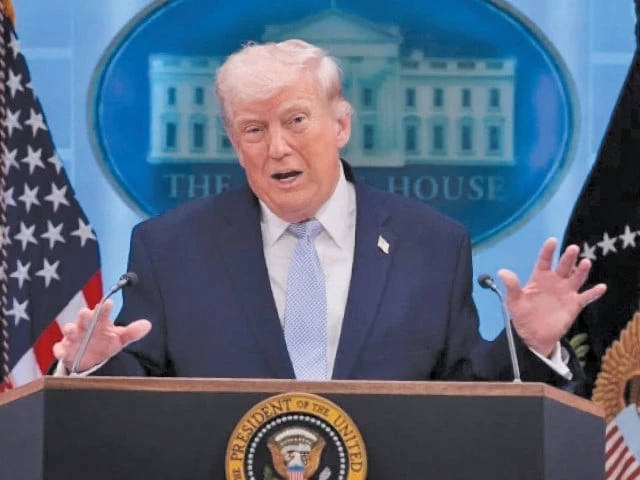
US President Donald Trump announced an extension of the ongoing ceasefire with Iran on Tuesday evening, saying the decision was made following a request from Pakistan’s top leaders and to give Tehran time to present a unified proposal for a permanent resolution to the conflict.
In an article on Truth Social, Trump said the truce, which was set to expire in a few hours, would remain in effect until Iran submits a comprehensive plan and negotiations reach a final outcome.
“Based on the fact that the Iranian government is seriously fractured, which is not surprising, and at the request of Field Marshal Asim Munir and Prime Minister Shehbaz Sharif of Pakistan, we have been asked to continue our attack on the country of Iran,” Trump wrote.
He added that the US military had been instructed to maintain pressure on Iran while avoiding immediate escalation.
“I have directed the U.S. military to continue the blockade and, in all other respects, remain ready and capable,” he said.
Trump said the extension was conditional and temporary, aimed at creating space for diplomacy amid signs of internal divisions within Iran’s leadership.
Reacting to the announcement, an adviser to Iran’s parliamentary speaker and chief negotiator Mohammad Baqer Qalibaf said US President Donald Trump’s extension of the ceasefire was a “ploy to buy time” for a surprise strike.
Qalibaf’s adviser said in an article on
Iran’s Tasnim news agency, citing Iranian officials, said: If the United States wants to maintain the shadow of war, it should consider the Strait of Hormuz to be completely closed.
“Continued naval blockade amounts to continued hostility; as long as the blockade persists, Iran at least will not reopen the Strait of Hormuz, and if necessary, it will break the blockade by force.”
Meanwhile, Prime Minister Shehbaz Sharif thanked the US President for extending the ceasefire. “On my own behalf and on behalf of Field Marshal Syed Asim Munir, I sincerely thank President Trump for graciously accepting our request for an extension of the ceasefire to allow ongoing diplomatic efforts to take their course,” he wrote in a post on X.
“With the confidence reposed in it, Pakistan will continue its earnest efforts towards a negotiated settlement of the conflict.
“I sincerely hope that both sides will continue to respect the ceasefire and will be able to conclude a comprehensive “peace agreement” during the second round of talks scheduled in Islamabad to definitively end the conflict.”
The development comes at a critical time, as diplomatic efforts intensify to transform the fragile truce into a broader agreement.
Pakistan has actively facilitated indirect contacts between Washington and Tehran, seeking to prevent further escalation and push both sides toward a negotiated settlement.
Tehran had previously expressed its reluctance to confirm its participation in peace efforts, which prompted the American delegation led by the vice president to postpone its departure for Islamabad on Tuesday.
The lack of clarity has disrupted diplomatic dynamics, with the US team yet to leave Washington despite extensive preparations for talks scheduled for Wednesday.
The US delegation was due to leave for Islamabad on Tuesday evening, Pakistan time, but Iran’s refusal to send its team has jeopardized the process.
At 7:30 p.m. Pakistan Standard Time, Information Minister Attaullah Tarar said Islamabad was still awaiting a formal response from Tehran regarding the composition and arrival of its delegation.
“An official response from the Iranian side regarding confirmation of participation of a delegation in the Islamabad peace talks is still awaited,” Tarar said, adding that Pakistan, as a mediator, remains in constant contact with Iranian authorities and continues to pursue diplomacy and dialogue.
The two-week ceasefire was set to expire at 4:50 a.m. PT on April 22, although conflicting timelines have now emerged, adding to the confusion.
While Pakistan maintains the ceasefire ends early Wednesday morning, Iranian officials suggest the truce could last nearly 24 hours more. US President Donald Trump, for his part, vaguely indicated that the ceasefire would end “Wednesday evening”, without leaving a clear consensus on the exact deadline.
The situation became complicated on Tuesday with the emergence of controversy over US actions at sea and Iran’s preconditions for negotiations.
Iran’s ambassador to the United Nations, Amir Saeid Iravani, said Tehran had received signals suggesting Washington might be willing to lift its naval blockade.
He said the next round of talks could take place in Islamabad once that takes place, reiterating Iran’s stance that talks cannot happen under military pressure.
Tehran has consistently maintained that any negotiations should not take place under what it calls “the shadow of threats,” with particular reference to the reported U.S. naval presence around the Strait of Hormuz.
Iranian Foreign Minister Abbas Araghchi further escalated his remarks, calling any blockade of Iranian ports “tantamount to war” and a violation of the ceasefire.
In a statement, it also warned that targeting commercial ships or arresting their crews would constitute an even more serious violation.
“Iran knows how to neutralize sanctions, defend its interests and respond to pressure,” he said, signaling that Tehran is ready for both diplomacy and confrontation.
Diplomatic sources in Islamabad said Pakistan had intensified its efforts to persuade Tehran to join the process and prevent the collapse of the fragile truce.
The Foreign Office reiterated that Pakistan remained committed to facilitating engagement between the two sides, stressing that dialogue and diplomacy was the only viable path.
At the same time, confusion persists in Washington over the status of the American delegation’s travel plans.
Reports citing US officials suggested that Vice President JD Vance’s visit was postponed after Iran failed to respond to the US negotiating position. However, the White House has not officially announced whether the trip has been delayed indefinitely.
What is clear, however, is that Vance is not gone. US media reported that he remained in Washington to attend policy meetings at the White House, with no indication of an imminent visit to Islamabad.
Ishaq Dar
Deputy Prime Minister and Foreign Minister Ishaq Dar held talks with envoys of several countries and discussed regional developments.
During his meeting with US Charge d’Affairs Natalie Baker, Dar stressed that talks were the only “viable way” to address the current challenges.
“FM Dar underlined Pakistan’s continued emphasis on dialogue and diplomacy as the only viable way to address challenges and achieve lasting regional peace and stability,” said a statement issued by the Ministry of Foreign Affairs (MoFA).
The statement also mentioned that “FM Dar stressed the need for engagement between the United States and Iran, urging both sides to consider extending the ceasefire and giving diplomacy a chance.”
The statement noted that Natalie expressed the United States’ appreciation for Pakistan’s “constructive and positive role” in promoting regional peace and facilitating dialogue.
Earlier, Chinese Ambassador to Pakistan Jiang Zaidong expressed Beijing’s full support for Islamabad’s diplomatic efforts to facilitate engagement between the United States and Iran during a meeting with Foreign Minister Dar.
The ministry said on
The statement said the discussions also focused on the latest regional situation. Dar reaffirmed the “all-weather strategic cooperative partnership” between Pakistan and China, highlighting the strength of bilateral ties.
“He also stressed the importance of continuing high-level exchanges between the two countries,” the statement added.
Dar also spoke with Saudi Foreign Minister Prince Faisal bin Farhan Al Saud on Tuesday evening to discuss the latest regional developments, the Foreign Ministry said.
Both sides stressed the importance of dialogue and engagement to achieve lasting peace and stability in the region.
“The two leaders discussed the latest regional developments and stressed the importance of dialogue and engagement to achieve lasting peace and stability,” FO said in a statement.
He added that the Saudi Foreign Minister reiterated the Kingdom’s support for Pakistan’s continued efforts in this regard.
Both parties agreed to remain in close contact, he concluded.
Furthermore, Dar also had a telephone conversation with Egyptian Foreign Minister Badr Abdelatty to discuss the latest regional developments.
According to the Ministry of Foreign Affairs, the two ministers “underlined the importance of dialogue and engagement for peace and stability” during their discussion.
He added that the two sides agreed to remain in close contact as part of ongoing diplomatic coordination on regional issues.
FM Dar received unprecedented international recognition for its diplomatic leadership, as Pakistan positioned itself at the center of high-stakes mediation efforts during the escalating Iran-US-Israel crisis.
Over the past week, senior officials and influential voices from more than ten countries, including Saudi Arabia, Iran, the United States, China, Turkey, Azerbaijan, Bahrain and Uzbekistan, have publicly acknowledged Dar’s role in facilitating ceasefire negotiations.
Pakistan has emerged as a central facilitator on the sensitive diplomatic track, positioning itself as an “honest broker” amid sharply polarized positions between Washington and Tehran.
After 40 days of airstrikes, U.S. and Iranian negotiators began negotiations in Islamabad earlier this month, once again focused on the usual compromise between nuclear restrictions and economic relief.
When American and Iranian negotiators met last weekend in Islamabad, the United States proposed a 20-year suspension of all Iranian nuclear activity, while Iran suggested a three- to five-year halt, according to sources familiar with the matter.
The second round of negotiations is yet to officially begin in Islamabad, while Pakistan has further intensified its efforts to reach an agreement. However, obstacles remain in the negotiations, and problems persist on both sides.


