
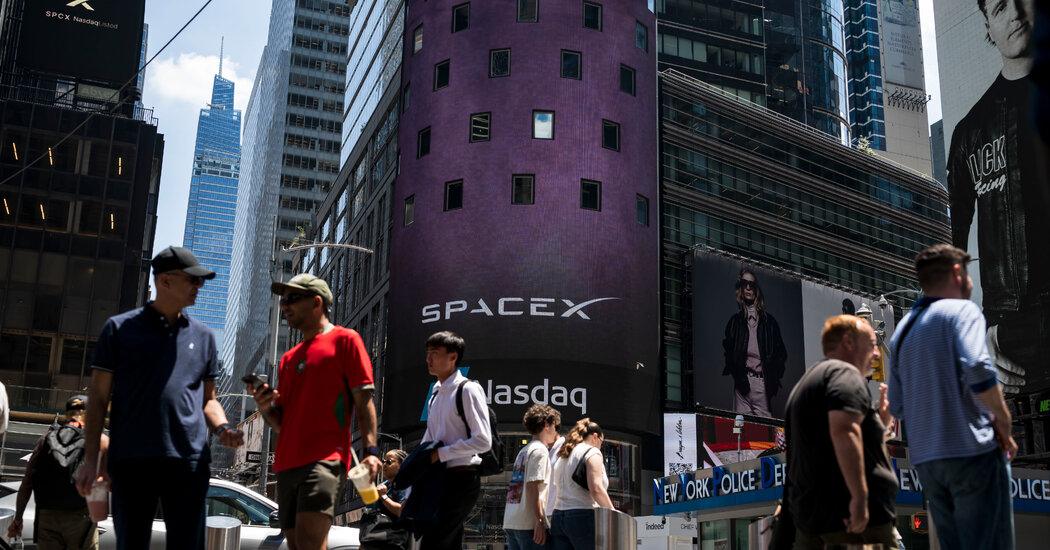
Two events that occurred last week help to crystallize this strange and contradictory moment for the American economy.
On Wednesday, the Bureau of Labor Statistics reported that soaring energy prices had wiped out a year and a half of wage gains for the average American worker. SpaceX’s entry into the public markets on Friday made Elon Musk the world’s first billionaire.
This stark juxtaposition helps explain why many Americans in survey after survey say they no longer believe the U.S. economy is working for them. A few people are becoming fabulously, unimaginably wealthy, even as entire generations of families fear they will never be able to afford to buy a home, raise children, or enjoy a comfortable retirement.
“I don’t think the stock market is necessarily the cause of Americans’ pessimism about the economy,” said Stefanie Stantcheva, a Harvard professor who studies public opinion. “But I don’t think people look at it and think, ‘Great, that means I’m going to do really well, too.’ This potentially reinforces that “I’m late” feeling.
Inequality is nothing new in America. But the explosion of wealth at the top is unprecedented in U.S. history. At the height of the Gilded Age in the late 19th century, the richest handful of Americans had a net worth equivalent to about 3 percent of the country’s annual economic output, according to data compiled by French economists Gabriel Zucman and Emmanuel Saez. Today, the wealth of that same 0.00001 percent – or about 20 individuals – represents a share roughly four times larger, equivalent to 12 percent of annual output.
Other economists, using different methodologies, arrive at somewhat different figures. But almost no one disputes the basic fact that the richest few have made extraordinary gains in recent years.
The situation for the other 99 percent of Americans is more nuanced. More than half of U.S. households own stocks, either directly or through retirement accounts, meaning they have benefited at least somewhat from the record rise in stock prices. Wealth has grown more slowly for middle-class families than for the wealthy over the past decade, according to Federal Reserve data, but it has still increased.
However, for most Americans, “wealth” is a somewhat abstract concept, tied to the home they live in and the retirement accounts they hope to leave intact for as long as possible. What matters most on a daily basis is their income. And workers’ share of national income has been declining for decades. It hit a record high in the first quarter of the year, according to Commerce Department data.
Today, rising costs are once again eating into workers’ wages. The recent rise in energy prices – a result of the war with Iran – pushed the annual inflation rate to its highest level in three years in May. Hourly wages, adjusted for inflation, have fallen for three straight months, erasing all of the gains made during President Trump’s first year in office. Measures of consumer confidence fell as gas prices rose.
Oil prices have fallen somewhat in recent weeks on hopes of a lasting ceasefire, and are expected to fall further if the United States and Iran reach a deal and tankers begin leaving the Persian Gulf in greater numbers through the Strait of Hormuz.
But aid at the pump is unlikely to end Americans’ anxiety after years of successive economic shocks. First, the Covid-19 pandemic has paralyzed large parts of the economy and put tens of millions of people out of work, at least temporarily. Inflation then reached its highest level in four decades. Since then, Americans have faced repeated high interest rates, tariffs and recession fears.
“If you think about what it was like to go through Covid, and then inflation, and also political unrest and instability, you come away from those things thinking, ‘How am I supposed to plan for the future?’ ” said Elizabeth Wilkins, president of the Roosevelt Institute, a left-leaning think tank.
Ms. Stantcheva, an economist at Harvard, has found that bouts of high inflation have long-term adverse consequences on consumers’ economic attitudes. This is not only because of the pressures on their budgets, but also because it seems unfair: the rich are able to absorb higher prices relatively easily, while lower-income households struggle.
“It goes hand in hand with a great sense of inequity and injustice,” she said.
Today, Americans face a new threat in the form of artificial intelligence, which tech industry executives say could eliminate entire categories of white-collar workers. Many economists are skeptical of these predictions, but polls show that many workers worry about the impact of technology on their careers. Voters across the country have also rebelled against plans to build AI data centers in their communities, citing their impact on electricity bills, water supplies and air quality.
Given these concerns, it is not surprising that the public is uneasy about the increase in wealth that has accompanied the AI boom. Technology-related companies have driven the stock market’s recent gains. SpaceX’s debut Friday was the first in what is expected to be a series of giant IPOs for AI companies. (SpaceX, while best known for its rockets and satellites, also has an AI lab and has made huge investments in AI infrastructure.)
In addition to making Mr. Musk a billionaire, the SpaceX IPO alone was expected to create thousands of new millionaires and several billionaires.
“A lot of the tech moguls who are today’s super-rich haven’t helped themselves into the conversation by saying, ‘My innovation is going to destroy your life,'” said Glenn Hubbard, an economist at Columbia Business School who served as a top adviser to President George W. Bush. “It’s not too crazy to imagine a violent reaction.”
Mr. Hubbard said he didn’t necessarily see a problem with the existence of billionaires, or even trillionaires, as long as people got rich through entrepreneurship and innovation rather than through corruption or cronyism. But he added that policymakers should take public attitudes seriously. Congress should consider ways to tax billionaires more effectively, he said, and ensure that the wealthy do not exert undue influence over the political system.
Many progressive economists, however, argue that enormous fortunes like Mr. Musk’s inherently distort the economic and political systems, giving the super-rich too many ways to evade regulation, taxation and surveillance.
“It’s the power to influence markets, it’s the power to buy off competitors, it’s the power to influence policymaking,” said Mr. Zucman, one of France’s specialists on wealth inequality. “If you want a well-functioning market economy, it’s not good to have overly concentrated power with extreme wealth at the top. It distorts markets. It distorts democracy.”
The AI boom is still in its infancy, and some analysts doubt that SpaceX and other companies will turn a profit to justify their sky-high valuations. If the skeptics are right, stock prices could fall and Mr. Musk’s billionaire status could prove short-lived.
But such a decline could also have consequences for ordinary Americans. AI investments have helped the economy weather tumultuous times; the stock market boom helped support consumer spending as wage growth slowed. A bursting of the AI bubble would put millions of jobs at risk, from electricians who wire data centers to waiters serving wealthy investors in high-end restaurants. And it would vaporize billions of dollars of paper wealth held in 401(k) accounts and college savings plans.
This can make AI seem like a dead end for workers: If the technology succeeds in reshaping the economy, they could lose their jobs. If they fail to meet expectations, their retirement savings could evaporate. It’s no wonder so many Americans feel like the economy is working against them, said Heather Boushey, who served as an adviser in the Biden administration and wrote a book on the economic impact of inequality.
“Clearly, our economy is designed to create a handful of billionaires and a trillionaire,” said Heather Boushey, who served as an adviser in the Biden administration and wrote a book on the economic impact of inequality. “It’s no longer about creating opportunity and stability for the majority. »


