
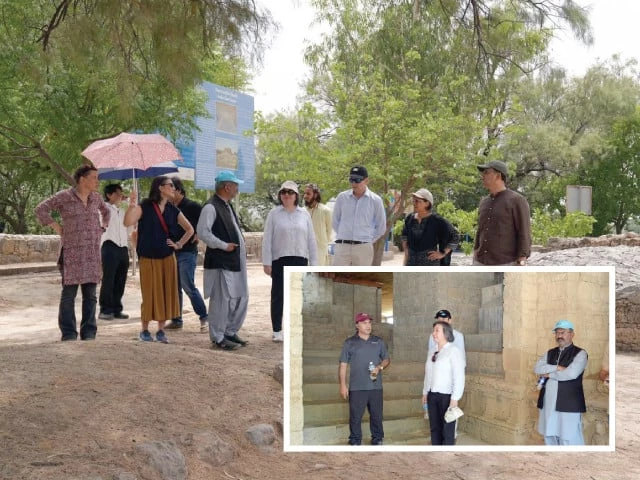
World Bank Vice President Mamta Murthi and her delegation visit the UNESCO-listed Sirkap Ruins and Taxila Museum during a visit to the ancient heart of Gandharan in Pakistan. PHOTOS: EXPRESS
TAXILE:
A high-level delegation led by World Bank Vice President Mamta Murthi visited the ancient city of Taxila and its internationally renowned archaeological sites to review the historical legacy of the Gandhara civilization, its cultural significance and ongoing preservation efforts.
The delegation began its visit at the Taxila Museum, where it was received by SRO Taxila Deputy Director Muhammad Asim Dogar and Senior Archaeologist Dr Arsalan.
The officials provided a detailed briefing on the museum’s vast collection of Gandharan artifacts, Buddhist architecture, sculptures and other archaeological treasures.
The delegation was informed that the museum is one of the most important repositories of Gandharan heritage in South Asia, housing sculptures, coins, jewelry, pottery and other rare objects dating back thousands of years.
The members of the delegation visited the galleries of the museum and expressed particular interest in its unique examples of Gandharan art.
The delegation then visited the UNESCO World Heritage sites of Sirkap and Dharmarajika Stupa. Archaeologists informed visitors of their historical significance, noting that Sirkap was one of the main urban centers of ancient Taxila, while the Dharmarajika stupa is considered one of the holiest religious sites in Buddhism.
The delegation also visited the ancient Buddhist monastery of Jaulian in Khyber Pakhtunkhwa, an important monument of the height of Gandhara civilization.
The visitors were received by the Director General of Khyber-Pakhtunkhwa Archaeology, Dr. Abdul Samad, who provided a comprehensive briefing on the historical significance of the monastery, archaeological research, conservation and restoration projects and tourism potential.
Dr Abdul Samad told the delegation that Jaulian had been a major center of Buddhist learning and religious activity, with finds at the site providing valuable evidence of the intellectual and cultural achievements of the Gandhara civilization.
He said the provincial government and the archeology department were pursuing various initiatives aimed at preserving and promoting the historical heritage of the region at the international level.
During the visit, the World Bank delegation praised the ongoing efforts to conserve, restore and promote archaeological sites. The members of the delegation highlighted that Pakistan’s cultural heritage was of not only national but also global importance and stressed the need to strengthen international cooperation for its preservation.
Experts have noted that Taxila and its surrounding archaeological sites reflect a unique blend of Buddhist, Greek, Persian and indigenous civilizations, making the region one of the most important historical centers in the world.
Officials described the World Bank delegation’s visit as an important step towards showcasing Pakistan’s cultural heritage on the global stage and bringing greater international attention to its preservation.


