
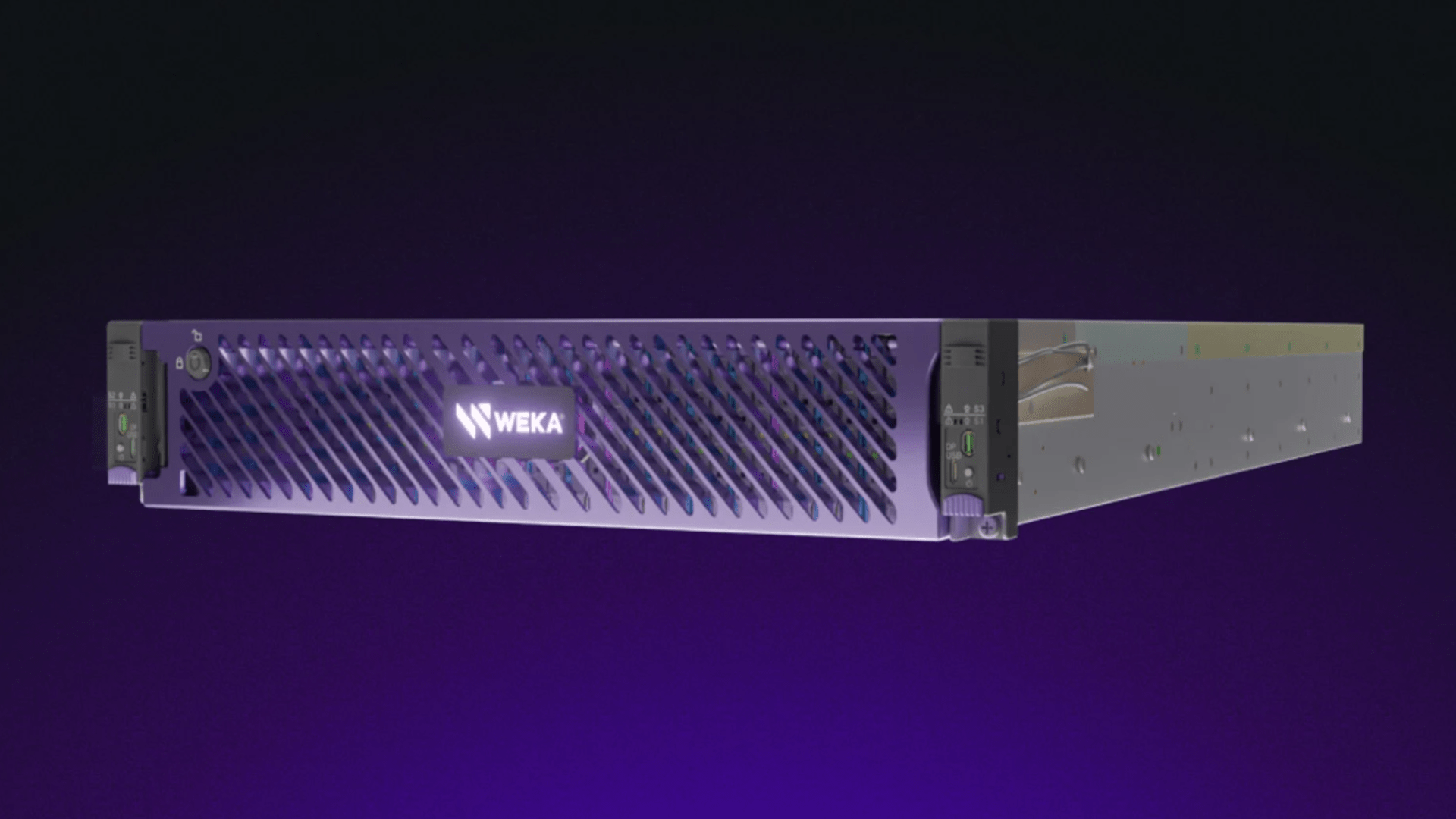
- WEKApod 3 Achieves Exabyte Capacity with Software Combined with Dense Micron Storage
- NeuralMesh 6 transforms 441.5 PB of flash into claimed exabyte-scale storage capacity
- WEKApod 3 leverages compression to overcome raw storage hardware limits
WEKA has launched WEKApod 3, a line of storage appliances specifically designed to run its new NeuralMesh 6 software at rack-scale density.
The flagship Prime Max configuration claims 1.1 exabytes of effective capacity in a single 56U rack, positioning it as the first system to cross this threshold.
Using Micron’s 245.76TB ION 6600 SSDs on approximately 1,800 drives per rack produces only 441.5PB of raw hardware capacity, or well under half an exabyte.
Latest videos fromTechRadar
Software tiering closes the capacity gap
This means that the advertised exabyte-scale capacity is heavily dependent on data reduction technologies rather than just installed flash.
This configuration packs 70 NVMe drives into a compact, two-rack, two-node chassis for maximum density.
Fingerprinting, similarity hashing, deduplication, and compression are performed by default on every deployment, with write overhead kept below 5%.
WEKA claims up to 6x capacity savings specifically on AI training data, backed by a contractual guarantee covering both reduction rate and performance.
This is where NeuralMesh 6 and WEKApod 3 truly work as a single integrated product rather than as separate announcements.
AlloyFlash tiering automatically routes latency-sensitive operations to TLC flash while sending high-capacity data to QLC drives, which operate approximately 30-40% cheaper per terabyte.
Throughput per rack reaches 10.2 TB/s with 210 million IOPS, figures according to WEKA, surpassing the next best publicly available alternative by 114% in terms of throughput density.
Jeremy Werner, senior vice president of Micron’s Core Data Center business unit, said the architecture associated with Micron’s 245TB SSDs provides 15.8 petabytes in a single 2U footprint.
Steve McDowell, chief analyst at NAND Research, argued that production-scale inference workloads require different metrics than training, highlighting tokens per rack and cost per inference as numbers buyers should now track.
Constraints force storage vendors to completely rethink hardware
WEKA points to several structural pressures behind this hardware approach, starting with a documented decline in U.S. data center construction in 2025.
Queues for grid connection in major markets now stretch four to seven years before new capacity comes online.
Morgan Stanley has projected a 49 gigawatt electricity deficit in the United States through 2028, exacerbating existing NAND supply constraints.
WEKA claims that inefficient storage directly competes with GPUs for the same limited rack space and power budget.
By managing its own hardware supply chain instead of relying on third-party OEM channels, the company says it can offer more predictable pricing and delivery times.
NeuralMesh 6 will be released in the second half of 2026, and existing customers will be able to upgrade at no additional cost.
WEKApod Nitro, Prime and Prime Max can already be ordered through the WEKA distributor network, with deliveries beginning in fall 2026.
Via Storage Review
Follow TechRadar on Google News And add us as your favorite source to get our news, reviews and expert opinions in your feeds.


