
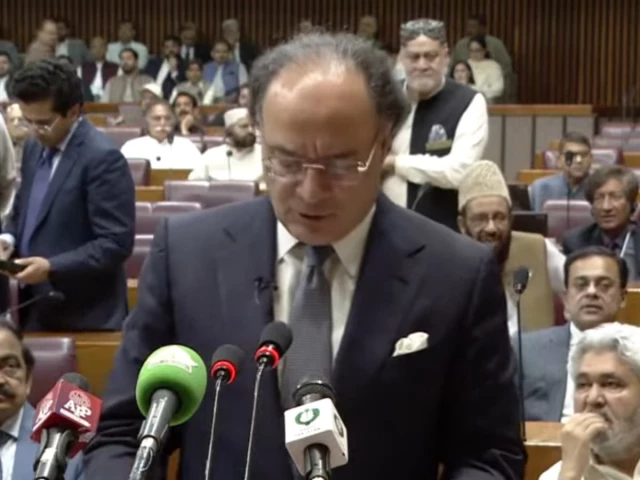
Finance Minister Muhammad Aurangzeb presents the 2026-27 budget in the National Assembly on Friday. – SCREENSHOT
Finance Minister Aurangzeb presents federal budget for fiscal year 2026-27 as opposition disrupts proceedings with loud chants
Aurangzeb said, “Mr. President, it is a great honor for me to present the third budget of our government for the financial year 2026-27 before this august House.”
“Pakistan and Saudi Arabia have concluded a defense agreement, which marks a strategic partnership,” he said.
This budget comes at a time when Pakistan, in the eyes of its people and the world, has achieved the status of a country whose voice is heard and whose friendship is desired, he added.
Our defense industry has also become a source of valuable foreign exchange. This is proof that a strong defense is not only vital to our integrity, but can also contribute to the economic development of the country.
He said Pakistan had responded forcefully to India’s aggression. India was obliged to discuss peace. Our Bunyanum Marsoos operation was a major success.
Pakistan has achieved massive diplomatic success in recent months and managed to bring the United States and Iran to the negotiating table to resolve the regional conflict, he added.
The US and Iranian presidents have repeatedly praised the particularly important role of Prime Minister Shehbaz Sharif and COAS and CDF Marshal Syed Asim Munir. This is an unprecedented achievement that has enhanced our respect and stature in the committee of nations, and our efforts have been appreciated at all levels and in all forums, he said.
Aurangzeb said Pakistan-China relations remained “an important pillar of the economy”.
Regarding the economy, he said Pakistan’s economic growth reached 3.7 percent in the financial year 2025-2026 despite floods and regional conflicts, while the size of the economy reached $452 billion.
He said productivity in the large-scale manufacturing sector recorded its strongest growth in four years, while per capita income increased to $1,901.
The finance minister said foreign exchange reserves had increased from less than $4 billion three years ago to more than $17 billion, enough for about three months of imports.
On inflation, Aurangzeb said it stood at 7 percent and was expected to decline following the easing of tensions in the Middle East.
“Due to tensions in the Middle East, inflation has increased, but with the resolution of the conflict, the inflation rate will fall,” he said.
He said the recent conflict involving Iran had driven up international prices of gasoline and diesel, creating unexpected pressure on household budgets. However, he said the government did not pass on the full impact to consumers and instead provided a targeted oil subsidy of Rs128 billion during the recent oil crisis.
“Local gasoline and diesel prices do not fully reflect the strong severity of the international market,” he said.
Aurangzeb also said Pakistan had returned to the international bond market after four years, raising $750 million through Eurobonds.
He added that Pakistan first entered the Chinese capital market through a Panda bond issuance, where demand exceeded expectations.
The minister said 11 IPOs were launched on the stock exchanges during the year, while more than 250 companies started operations in Pakistan’s special technology zones.
“Pakistan’s image has improved considerably and its voice is being heard internationally,” he said.
The finance minister said the government was fulfilling its commitment to implement a long-delayed privatization program, arguing that the private sector would be the main driver of Pakistan’s future economic growth.
Aurangzeb recalled a commitment made during last year’s budget speech.
“During my budget speech before this House last year, we promised the nation that we would implement the privatization program which has been delayed for decades,” he said.
The minister said the government started with the privatization of First Women Bank and later completed the sale of Pakistan International Airlines (PIA).
“We started with the privatization of First Women Bank and then on December 23, 2025, the entire nation witnessed that through a transparent and live televised auction in Islamabad, Pakistan International Airlines was handed over to the private sector for a total of Rs185 billion,” he said.
Aurangzeb described the transaction as a “successful and historic privatization” carried out in line with Prime Minister Shehbaz’s vision that the private sector is the guarantor of sustainable economic growth.
“The private sector is going to run this country,” he told the House.
The Finance Minister said the government’s privatization program would continue, announcing that electricity distribution companies (DISCO), generation companies (GENCO) and airports would also be privatized.
Highlighting economic reforms, Aurangzeb said the Federal Board of Revenue’s tax collection increased from Rs7.2 trillion to Rs13 trillion in the last three years and is expected to reach Rs13 trillion by the end of the current fiscal year.
Among other economic indicators, he said the policy rate had fallen from 22 percent to 11.5 percent, while the State Bank’s foreign reserves had exceeded $17 billion.
Aurangzeb said industrial growth stood at 6.1 percent, while the services sector recorded growth of 4.1 percent.
“The productive capacity of industries is continuously increasing,” he said, adding that “major global companies are investing in Pakistan.”
Discussing governance reforms, Aurangzeb said the faceless customs valuation system had removed direct interaction between importers and tax officials to ensure transparency and improve revenue collection.
He added that 39,000 new companies had been registered with the Securities and Exchange Commission of Pakistan (SECP), reflecting increasing business activity.
On financial inclusion, the Finance Minister said the government had introduced five schemes aimed at providing finance to small borrowers and vulnerable segments of society.
He highlighted the Rs7.1 billion Agricultural Storage Financing Facility, under which storage facilities would be established across the country, enabling farmers to safely store grains and agricultural produce while obtaining bank financing on stored stocks.
Aurangzeb said the initiative was launched under the special leadership of the Prime Minister and aimed to accelerate financial inclusion while creating opportunities for skilled and marginalized groups.
He added that under the Zar Khezi project, loans worth Rs 300 billion were being given to 750,000 farmers.
The minister also highlighted the progress made under the government’s Digital Pakistan programme, saying a large number of traders had started adopting digital systems.
“Significant progress has been made under the Digital Pakistan and financial inclusion agenda,” he said, adding that the reforms had led to an increase in the number of banking users, rapid growth in digital transactions and a stronger foundation for a cashless economy.
According to Aurangzeb, the number of merchants integrated with the digital payment system increased to 1.67 million from 500,000 a year earlier.
He also told the House that a production control system had been put in place in 27 cement factories and 75 sugar factories.
Addressing demographics and employment, the Finance Minister noted that 68 percent of Pakistan’s population was under 30 years of age and stressed the need to create opportunities for the youth.
“Youth funding is the most important program,” he said, stressing that job creation remained a key priority of the government’s economic strategy.
Aurangzeb said the government was working to equip young Pakistanis with the skills and opportunities to become active contributors to the economy.
“Our youth are filled with skills, determination and the spirit of success. Prime Minister Muhammad Shehbaz Sharif is determined that every young Pakistani is provided with the skills, training and opportunities needed to become an active participant in the national economy,” he said.
The minister said that under the Prime Minister’s Youth Skills Development Scheme, implemented through NAVTTC, around 515,000 youth have so far received modern and conventional technical training.
Citing an independent evaluation, he said 53 percent of trained participants had already found employment.
Aurangzeb added that the program places special emphasis on women’s economic empowerment through IT-based training, enabling women to participate in the digital economy and self-employment sector from home.
This story is currently being updated.


