
According to the recent clashes, a Ranger official was killed and around 15 police and law enforcement officers were injured.
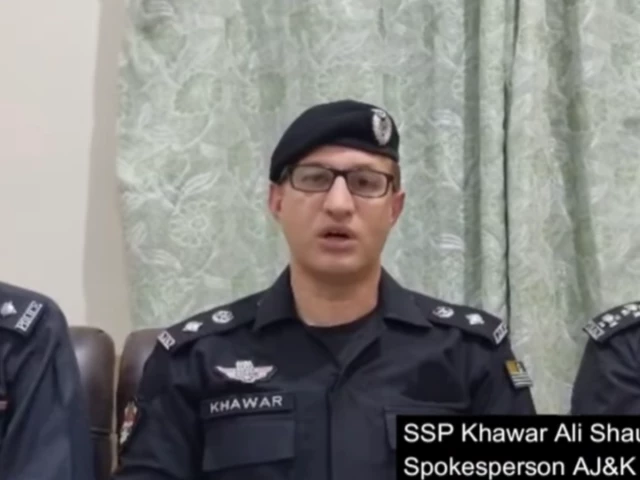
AJK Police Spokesperson SSP Khawar Ali Shaukat addressing a press briefing in Rawalakot. SCREENSHOT
Azad Jammu and Kashmir (AJK) Police spokesperson Senior Superintendent of Police (SSP) Khawar Ali Shaukat on Wednesday said the banned Awami Joint Action Committee (JAAC) was operating under an “agenda” to destabilize the region, accusing protesters of firing automatic weapons at security personnel from fortified positions inside buildings.
“This shows that the banned JAAC is working here on an agenda whose aim is to destroy peace in AJK, disrupt the social fabric of Kashmir and at the same time undermine the atmosphere of brotherhood and peace,” Shaukat said at a press conference in Rawalakot.
The statement followed reported clashes between law enforcers and protesters in Rawalakot during the first phase of AJK elections in Mirpur division two days earlier, with reports of several deaths and injuries circulating on social media. Several videos circulating online showed scenes of unrest, with allegations of violence and casualties, although details could not be independently verified. Security forces and the banned Awami Joint Action Committee (JAAC) claimed loss of life on both sides.
The SSP said the clashes exposed the “false narrative” on social media describing the movement as peaceful. “This is not a peaceful movement; it has become an armed group.”
According to Shaukat, armed groups attacked security personnel deployed in different parts of Rawalakot to maintain law and order, prompting police to launch operations.
He said state institutions had “always tried to exercise restraint,” but added that when “armed groups attack police and law enforcement, it becomes our constitutional and legal responsibility to act in accordance with the law.”
Describing the violence of the past two days, the AJK police spokesperson said individuals took up positions inside the buildings before opening fire on security forces with what he described as modern weapons.
“You saw how in the last two days they occupied buildings, established positions and opened fire on security forces and police officers using modern weapons,” he said.
Shaukat said the attacks resulted in the death of a Rangers official, while around 15 policemen and other law enforcement personnel were injured in the clashes.
Read: Casualties reported after clashes between JAAC and police in Rawalakot, AJK
Highlighting the scale of the violence, he said the use of heavy and automatic weapons showed those involved were “no ordinary organization.” “Its links lead elsewhere,” he added.
The spokesperson said police and other law enforcement agencies responded wherever attacks took place, despite their own losses.
He added that several people suspected of being involved in violent incidents were arrested during the operations.
According to Shaukat, agents recovered a cache of weapons from those detained, including pistols, automatic firearms, ammunition and what he described as American-made automatic weapons.
Standing in front of the weapons seized at the briefing, he said the display contradicted claims that those involved were peaceful protesters. “You can see the weapons displayed here: pistols, automatic weapons and ammunition. They were recovered from the arrested people,” he said.
He also rejected “online attempts” to present the security operation as an action against peaceful protesters. “The narrative that peaceful protesters are being targeted is contrary to the facts,” he said, pointing to the weapons displayed in front of journalists.
Shaukat accused “anti-state elements” of spreading what he described as negative propaganda on social media and said police would continue to show restraint in responding whenever security personnel were attacked.
Political parties demand a transparent investigation
The clashes in Rawalakot have drawn sharp criticism from political parties and rights groups. The Human Rights Commission of Pakistan (HRCP) said it was “deeply alarmed” by reports that several people had been killed and many others injured.
While recognizing that authorities have a duty to maintain public order, the HRCP said this “must never come at the expense of the right to life or the freedoms of peaceful assembly and expression”, calling for “a prompt, impartial and independent investigation” into the reported deaths and injuries and urging authorities to “exercise restraint” as the remaining phases of the elections approach.
Opposition alliance Tehreek-e-Tahaffuz-e-Ayeen Pakistan (TTAP) also condemned the use of “excessive force” against protesters, saying demonstrations had continued for weeks for “democratic rights, justice and the rule of law.” He claimed that the protesters had carried out a “peaceful march against unbearable inflation and unemployment”, alleged that opposition leaders who tried to mediate had been prevented from reaching the region and called on Pakistanis to oppose violations of democracy, the rule of law and human rights.
The Pakistan Tehreek-e-Insaf (PTI) also denounced the reported firing, calling for an “immediate, independent, transparent and impartial judicial investigation” to establish the facts and hold those responsible to account. He described the reported deaths and injuries as an attack on “human rights, democratic values and civil liberties,” and said “the voice of the people cannot be suppressed through any form of oppression or use of force.”
Learn more: HRCP calls for impartial and independent investigation into reports of deaths during Rawalakot clashes
Jamiat Ulema-e-Islam-Fazl (JUI-F) leader Maulana Fazlur Rehman also condemned the violence, calling the shooting of civilians “open terrorism”. He said protesting against government policies was a constitutional right, asked: “Are people not even allowed to raise their voices for their rights? ” and urged authorities to immediately end what he described as oppression in the region.
Background
The 53-member AJK Legislative Assembly has 12 seats reserved for Kashmiri refugees – people who fled Indian Illegally Occupied Jammu and Kashmir (IIOJK) in 1947 and 1965 and are now scattered across Pakistan. Six seats represent refugees from the Jammu division (~434,000 people) and six from the Kashmir Valley (~30,000 people) – an already lopsided arrangement that many see as unfair.
The region experienced one of its most turbulent periods in October last year, when JAAC-led protests erupted demanding constitutional and governance reforms. At least nine people, including three police officers, were killed during the unrest.
The JAAC, which organized the protests and strike, had presented a broad charter of demands, including an end to the privileges enjoyed by the ruling elite, the removal of 12 assembly seats reserved for refugees and the abolition of the quota system.
Two days after the violence, the government and the JAAC reached an agreement on 12 basic points and 13 additional points. Under the agreement, both sides agreed to constitute a high-level committee to look into the issue of refugee seats in the AJK Legislative Assembly.
The file is currently at an impasse, with the JAAC demanding the removal of these seats while the government rejects this request.


