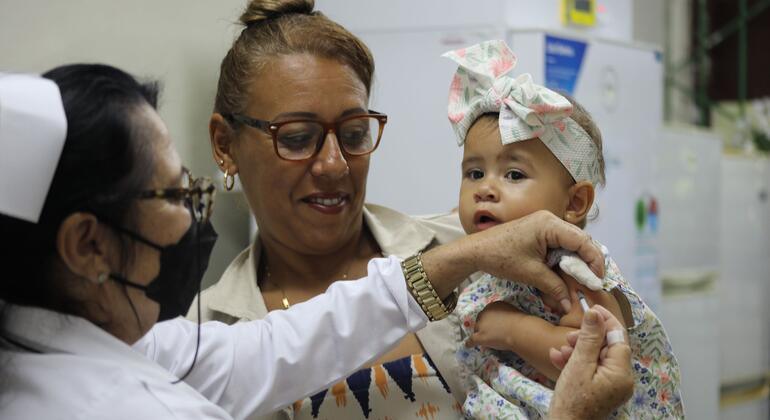
During World Immunization Week, which runs from April 24 to 30, the World Health Organization (WHO) and its partners are highlight the benefits of vaccines at every stage of lifeas well as scientific advances that have led to proven vaccinations against malaria, HPV, cholera, dengue, meningitis, RSV, Ebola and mpox.
This year marks the halfway point of the 2030 Immunization Agenda, a global initiative led by WHO to ensure that everyone can benefit from life-saving vaccines. A report released to assess progress so far finds that despite unprecedented challenges – including the COVID-19 pandemic, geopolitical instability, climate change and limited funding – vaccination efforts over the past five years have prevented millions of deaths.
However, most goals remain out of reachwith persistent gaps in systematic coverage, equity and epidemic prevention in many countries.
The United Nations health agency calls renewed commitments to build more sustainable national programs, stronger integration with primary health care and greater prioritization from global health agencies and partners.
Big results for children
On Friday, WHO, in collaboration with the United Nations Children’s Agency (UNICEF) and the Vaccine Alliance (GAVI), announced that The Big Catch-Up, a historic international effort to combat the decline in immunization due largely to the COVID-19 pandemic, reached approximately 18.3 million children aged one to five years in 36 countriessince its launch in 2023.
The campaign also provided 23 million doses of inactivated polio vaccine (IPV) to unvaccinated and under-vaccinated children, a critical intervention for polio eradication. The initiative is expected to be on track to meet its goal of vaccinating at least 21 million children.
Don’t miss a video report from UNO New Jersey in which a family reflects on how vaccinations help protect the youngest members of the community, allowing them to grow up safe enough to just be kids. The report will be available on PK Press Club next week.