
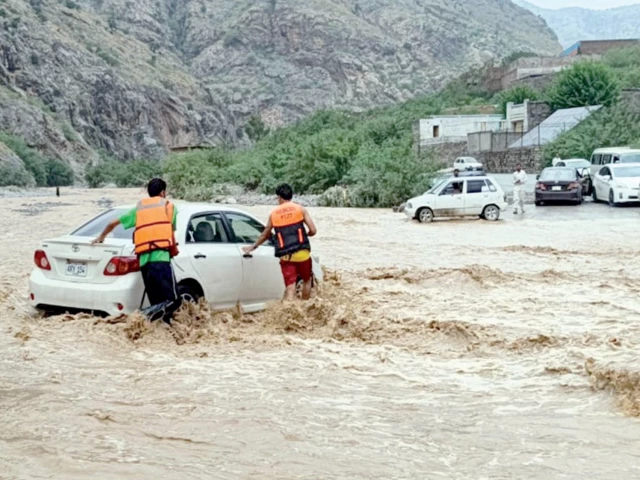
FLASH FLOODS: Rescuers help stranded motorists after heavy monsoon rains flooded roads in Landi Kotal, Khyber district. PHOTO: IPP
PESHAWAR/ISLAMABAD:
Water levels rose Monday in Pakistan’s major rivers as heavy monsoon rains swelled flows and officials said discharges from spillways upstream of Indian dams added to inflows, prompting new flood alerts, tapping of Tarbela Dam’s spillways and increased monitoring of the river system.
According to official figures, the total flow of the country’s rivers reached 454,000 cusecs.
The Chenab river carried about 130,000 cusecs, while the Indus recorded flows of 232,000 cusecs at Tarbela, 243,000 cusecs at Kalabagh, 247,000 cusecs at Chashma, 210,000 cusecs at Taunsa, 164,000 cusecs at Guddu and 110,000 cusecs at Sukkur dam.
The water flow of the Jhelum river has also increased, with 57,000 cusecs recorded at the Mangla dam.
Authorities attributed the rise in river levels to widespread monsoon rains and the opening of spillways from Indian dams upstream. Total water storage in the nation’s reservoirs was 6.1 million acre-feet.
In addition, authorities also warned that an intense heatwave in Skardu and other northern areas, where temperatures reached 37 degrees Celsius, had accelerated the melting of snow and glaciers, increasing the risk of flooding from glacial lakes.
To manage the inflows, the authorities tapped the spillways of the Tarbela Dam and decided to keep the reservoir at the maximum possible vacant capacity to accommodate flood waters arriving from the northern catchments.
The spillways, open on Sunday at 4 p.m., were to be closed on Monday at noon.
Meanwhile, according to the 6 am update of the Flood Forecasting Division, light flooding persisted at Head Khanki and Head Qadirabad on the Chenab River, while the flows of the Indus, Jhelum, Ravi, Sutlej and Kabul rivers remained within normal limits at major gauging stations.
The division said the water level of Tarbela Dam stood at 1,506.01 feet, which is 58 per cent of its storage capacity, compared to 80 per cent on the same day last year. The level of Mangla dam was recorded at 1,175.85 feet, or 40% of its capacity, compared to 50% a year earlier.
During the previous 24 hours, the highest flows were recorded on the Chenab River, where Marala Head received 178,467 cusecs, Khanki Head 169,146 cusecs and Qadirabad Head 157,156 cusecs, all at average flood level. The Jhelum river in Mangla recorded a flow of 70,000 cusecs.
The Flood Forecasting Division warned that medium to high flooding may develop at Head Marala, Head Khanki and Head Qadirabad during the next 24 hours, while low to medium flooding was expected at Mangla on the Jhelum. Minor flooding was also forecast at Tarbela, Kalabagh and Chashma on the Indus.
Water levels also increased in the Deg Nullah at the Kingra Bridge on the Ravi River, where flows reached 10,193 cusecs, placing the stream at a low flood stage.
Later in the day, officials reported that inflows to Head Marala reached 110,355 cusecs, while outflows stood at 88,082 cusecs, indicating low-level flooding. At Mangla, inflows into the Jhelum increased sharply to 133,000 cusecs, leading to average flooding, although downstream discharges remained within normal limits.
Victims
Meanwhile, deteriorating weather conditions have also claimed lives in different parts of the country.
In Khyber district, three people died after being swept away by flash floods triggered by torrential rains in Landi Kotal.
A spokesperson for Rescue 1122 said the death toll rose to three after rescue teams recovered the bodies of a woman, a man and a child. The woman and man were found in Jabba Khwar area of Jamrud, while the child’s body was found in Parang Sam with the help of local residents.
According to the spokesperson, Rescue 1122 divers and local volunteers carried out a joint search operation before handing over the bodies to the competent authorities for legal formalities. The rescue service urged the public to avoid rivers, streams and seasonal waterways during heavy rain and to call 1122 immediately in an emergency.
The floods followed torrential rains in Landi Kotal and other upper parts of Khyber district, where seasonal swollen rivers swept away several vehicles. Authorities said no other casualties had been reported.
Meanwhile, heavy rains also lashed Peshawar and Nowshera, dropping temperatures significantly after days of hot and humid weather.
In Azad Jammu and Kashmir, three members of a family were killed and two others injured after a rain-triggered landslide hit a house in Hatli Bala village of Nikyal tehsil in Kotli district.
Authorities said a mother, daughter and son died when the hillside collapsed on the house. Their bodies were recovered from the rubble and buried, while the injured were shifted to the Tehsil headquarters hospital. A loaded truck was also swept away by floodwaters in the area.
Heavy rain and downpour also caused widespread destruction in Neelum Valley, damaging infrastructure and disrupting normal life.
Elsewhere, torrential rains continued to lash Hazara division, causing seasonal streams and nullahs to overflow, triggering landslides and blocking several roads.
In Abbottabad, heavy monsoon downpours severely disrupted daily life. Flooding in the Tarnawai Nullah has cut off a link road to Reala, halting traffic as no bridge exists at the crossing. Hundreds of trucks carrying phosphate were stuck on both sides of the flooded road.
Intermittent rains also continued in Balakot and the Kaghan Valley, where flash floods forced the temporary closure of the road leading to Saif-ul-Muluk Lake and another road in Sahuch. Machines belonging to the Kaghan Development Authority (KDA) and the National Highway Authority (NHA) were deployed to clear debris and restore traffic, while several tourist vehicles and jeeps remained stranded.
In Haripur, heavy rains flooded low-lying areas after local rivers overflowed. Deputy Commissioner Haripur said residents living near the waterways had been shifted to safer places.
The increased flow of the Indus has also filled the Tarbela Dam, prompting authorities to operate its spillways to release excess water.
Authorities have urged the public to avoid unnecessary travel, stay away from rivers, streams and flood-prone areas, and follow official advisories as the current monsoon system continues to affect the country’s northern regions.


