
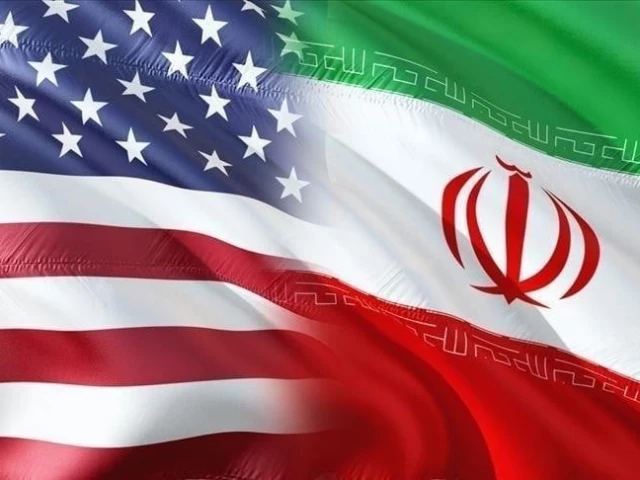
Trump said Monday that Iran was seeking talks with the United States and that they had been scheduled, without specifying a time or location. PHOTO:FILE
KARACHI:
Iranian-American academic and political scientist Vali Nasr says the ongoing war between Iran and the United States is not about military superiority but endurance, pointing out that Pakistan played a vital role in facilitating talks and de-escalating the situation.
Speaking on Express24/7’s “Full Frame” show with lead anchor Fahd Husain, Nasr laid out the anatomy of a crisis driven as much by timing as by power. “It’s not about who has the biggest bombs,” he said. “It’s about who has the most endurance and pain tolerance.”
At a time when the Middle East is on the brink of escalation, even as diplomacy moves toward a possible breakthrough, Pakistan has become the center of global attention.
Nasr stressed that Pakistan has played a key role in maintaining dialogue, building trust with Tehran and coordinating with regional powers. He said the country’s involvement had transformed the crisis into a defining moment for Islamabad’s diplomatic position.
“The Pakistanis played a very important role in keeping this going,” he stressed. “There is no other game in town than Islamabad,” he added, explaining that Pakistan’s strength lies in its neutrality.
Nasr described the Islamabad talks as an unprecedented moment in Pakistan’s recent history. “Two or three years ago, we would never have predicted that Pakistan would have this kind of influence,” he said.
Reflecting on the latest round of negotiations, Nasr noted that the 9 p.m. talks marked the most substantive direct engagement between the United States and Iran. “The importance of this cannot be overstated,” he added.
Despite progress on the diplomatic level, the situation on the ground remains precarious. The ceasefire window is narrow and military pressure continues to intensify, while Donald Trump has ordered a blockade of the Strait of Hormuz.
Nasr, however, offered a more strategic reading of the scenario, suggesting that the blockade of the main waterway responsible for 20% of the global flow of oil may not be a simple escalation but a form of leverage.
Nasr is professor of international affairs and Middle East studies at the Johns Hopkins School of Advanced International Studies in Washington. The full interview will be broadcast again on Wednesday at 9 a.m., 12 p.m., 3 p.m. and 6 p.m. on Express24/7.


