
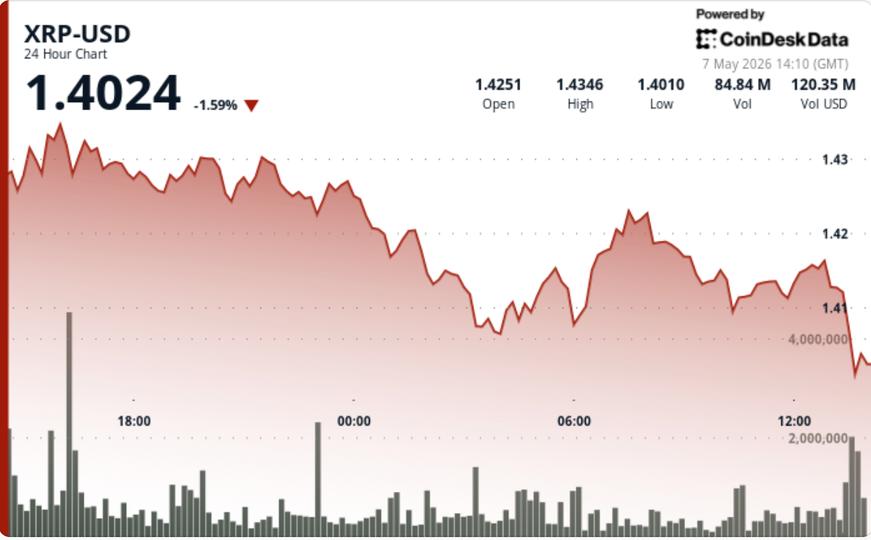
XRP gave up ground after failing to hold above $1.45, the pullback coming even as Ripple moved deeper into institutional finance thanks to a symbolic Treasury cross-border settlement alongside JPMorgan and Mastercard. This drop is significant because XRP is now near the same breakout zone that traders were waiting for confirmation of just days earlier.
News context
• Ripple, JPMorgan, Mastercard and Ondo Finance completed a near real-time cross-border redemption of tokenized US Treasuries on the XRP Ledger, with settlement finalized in less than five seconds.
• The transaction was routed through Mastercard’s multi-token network before JPMorgan’s Kinexys platform delivered dollars to Ripple’s banking partner in Singapore outside of regular banking hours.
• The pilot adds to the growing institutional focus on tokenized financial infrastructure, with DTCC also preparing to launch its own tokenization platform later this year.
Price Action Summary
• XRP rose from $1.4534 to $1.4137 during the 24-hour session, reversing from an earlier surge towards $1.45.
• Heavy selling occurred during the May 6 session at 1:00 p.m. UTC, when volume of 131.28 million pushed the price through support at $1.4460.
• The price then stabilized around the $1.41 area after a strong intraday rally from session lows near $1.409.
Technical analysis
• The rejection near $1.45 is significant because this level has repeatedly limited upside attempts during the broader consolidation range.
•
• The market is now compressing between support near $1.41 and resistance between $1.45 and $1.47, a range that appears increasingly unstable given diminishing liquidity conditions.
• Analysts continue to point to a broader bull flag structure over longer time frames, although shorter-term charts still show distribution pressure on rallies.
What traders should watch out for
• $1.40 to $1.41 is now the key support zone. Losing it would weaken the recent breakout structure.
• $1.45-1.47 remains the level that bulls must find to regain momentum towards $1.60 and above.
• Liquidity conditions remain tight, increasing the likelihood of sharper than normal moves once the range finally breaks.


