
Order emphasized that a vague assertion of “prior personal commitments” cannot, by any legal reasoning,
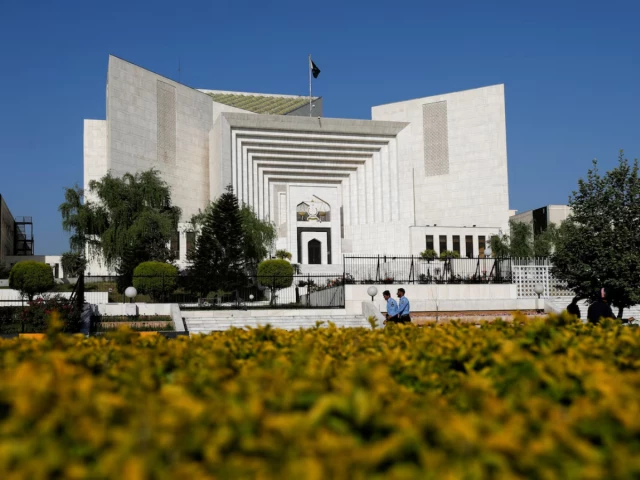
Police officers walk past the Supreme Court of Pakistan building, in Islamabad, Pakistan April 6, 2022. REUTERS
ISLAMABAD:
The Supreme Court has strongly opposed the growing trend of lawyers seeking adjournment of cases.
The court also warned lawyers that adjournments requested without strict adherence to the legal framework and without sufficient demonstrable reason will attract appropriate consequences, including the imposition of compensatory fees in accordance with the Supreme Court Rules.
“Despite the legal framework, repeated reminders and the established position that adjournments are only granted for sufficient reasons, the record submitted to the Court demonstrates that these principles are not followed in practice.
“We note, with immense disappointment, that the mandate governing adjournments is increasingly being ignored by lawyers,” said a seven-page judgment written by Chief Justice of Pakistan Yahya Afridi while hearing a case in which a lawyer sought an adjournment due to “prior personal commitments.”
The order emphasizes that a vague assertion of “prior personal commitments” cannot, whatever the legal reasoning, constitute sufficient cause for adjournment.
“On the contrary, it betrays a complete disregard for professional discipline and a disturbing lack of appreciation of the responsibility that comes with the privilege of being heard before this court.”
A division bench headed by CJP Afridi, in its order, noted that official data generated by the IT department of the court reveals a very worrying trend. Between January 2026 and March 2026, a total of 653 adjournments were requested by attorneys, the order states.
The order further highlights that what is more concerning is the fact that an overwhelming majority of adjournments are requested while the Court is assembled and cases are otherwise ready for hearing, thereby rendering significant judicial time unproductive.
“This data clearly reflects a pattern of informal, convenience-based requests made in defiance of binding rules and express cause list warnings, which is not expected of attorneys serving at the highest level of our justice system,” the order states.
The court made it clear that such a practice was completely unacceptable. Lawyers, not only in this court but across Pakistan, must understand the direct correlation between adjournments and the burden they place on the public exchequer.
The Court also said that unnecessary adjournments strike at the very heart of access to justice. For litigants, particularly those with limited means, repeated adjournments result in increased expenses and, in fact, a denial of timely justice.
This, in turn, erodes public confidence in the justice system and runs counter to the Court’s institutional efforts to ensure expeditious disposition of cases.


