
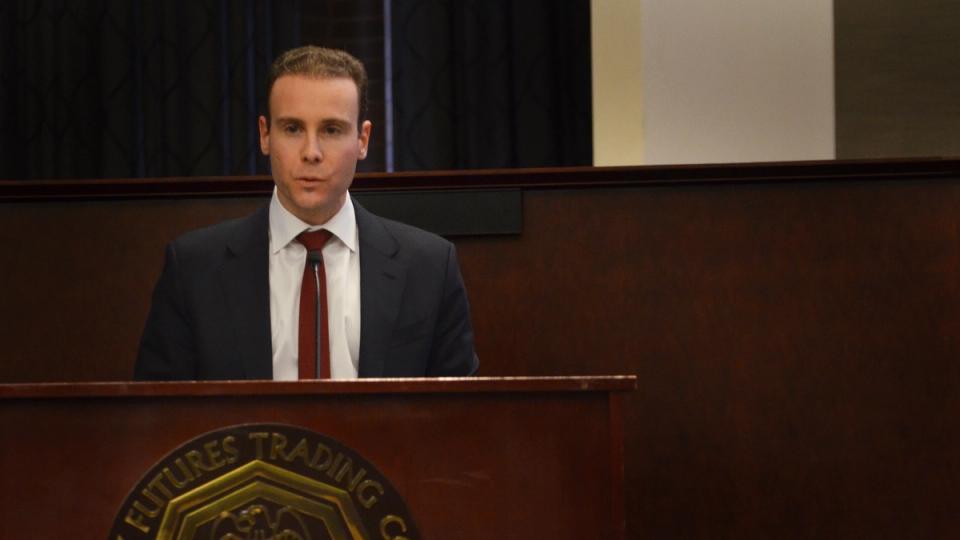
The U.S. Commodity Futures Trading Commission is relying on artificial intelligence and automation as it faces massive new oversight responsibilities, according to congressional testimony from Chairman Mike Selig, even as his agency’s workforce has shrunk significantly under President Donald Trump’s administration.
About a quarter of the CFTC’s staff has left their positions since 2025, following Trump’s demands to significantly reduce the federal workforce, according to agency records. But the CFTC is also called upon to regulate new, rapidly growing areas for the cryptocurrency and prediction markets.
“Tools like AI are going to be very helpful in monitoring and conducting investigations, and we’re integrating them into various workflows,” Selig told lawmakers on the House Agriculture Committee during a hearing Thursday, citing widespread use of Microsoft’s Copilot AI tool as a productivity aid. Asked about staffing cuts at his agency, Selig said, “we are operating more effectively and efficiently.”
“We’re putting a lot of work on your plate with digital assets, and we’re obviously going that route with prediction markets,” noted committee chair Glenn “GT” Thompson. He asked the CFTC chief for assurance that if he finds himself “in a situation where you know there is a need for additional qualified personnel,” he will seek help from the panel.
“Absolutely,” Selig replied.
He said adequate monitoring of the markets is one of his “top priorities,” even though the CFTC’s budget request for next year called for only three additional enforcement officers, or a staff of 108, still about 23% less than the 140 the division had in 2025.
The Digital Asset Market Clarity Act that the Senate continues to work on would elevate the CFTC to a central role in non-securities trading of cryptocurrencies, which would include transactions in high-profile assets such as bitcoin. and Ethereum ether (ETH). The agency also claims dominant legal jurisdiction over prediction markets, like those of major companies Polymarket and Kalshi, which have grown from levels measured in millions of dollars a year ago to billions today.
Selig’s Democratic predecessor, former Chairman Rostin Behnam, had regularly argued that the agency would need more people to oversee crypto and that it did not have the resources to police the world as prediction markets expanded in depth and across a virtually limitless scope of contract subjects. During Selig’s brief tenure, prediction markets erupted with accusations of insider trading, a few of which were addressed by the companies themselves. But markets have come under scrutiny for some trades linked to U.S. military actions and government statements that suggest a small number of anonymous traders made big money on correct bets, suggesting the potential for insider trading by people with government knowledge.
The president acknowledged that “many investigations are underway” into prediction markets, without quantifying any numbers or discussing their direction. He said regulated platforms provide the first line of defense against insider trading, fraud and market manipulation in the hundreds of new markets (binary event issues) that emerge on the platforms every day, while the CFTC itself provides a second line of defense.
“We regularly reject contracts,” Selig noted. “We are actively looking at what is out there,” he said, adding that his agency has a “zero tolerance” policy toward illicit market activities.
“Anyone who engages in this behavior will be subject to the full penalties of the law,” he said.
But Rep. Angie Craig, the committee’s top Democrat, argued that the agency’s “staffing is too small,” especially considering the agency’s role as “the primary regulator of two of the most dynamic and volatile markets.”
“We must give the CFTC the staffing, funding and clear statutory authority it needs to do its job,” Craig said.
The reduced staffing at the regulator includes the commission itself, which is supposed to have five members under law — including two commissioners from the minority party — but which was left by the White House as Selig’s lone post. The president was asked about it several times during Thursday’s oversight hearing, including whether he would enforce the major rules as a one-person commission.
“We cannot, for the sake of the American people, slow down our rulemaking,” he said, suggesting he would act alone on new regulations. The CFTC is continuing a preliminary rules process to put in place guardrails for U.S. prediction markets, and Selig has also pushed policy initiatives in the crypto space.
Read more: CFTC sues Illinois, Arizona and Connecticut over states’ sports prediction market efforts


