
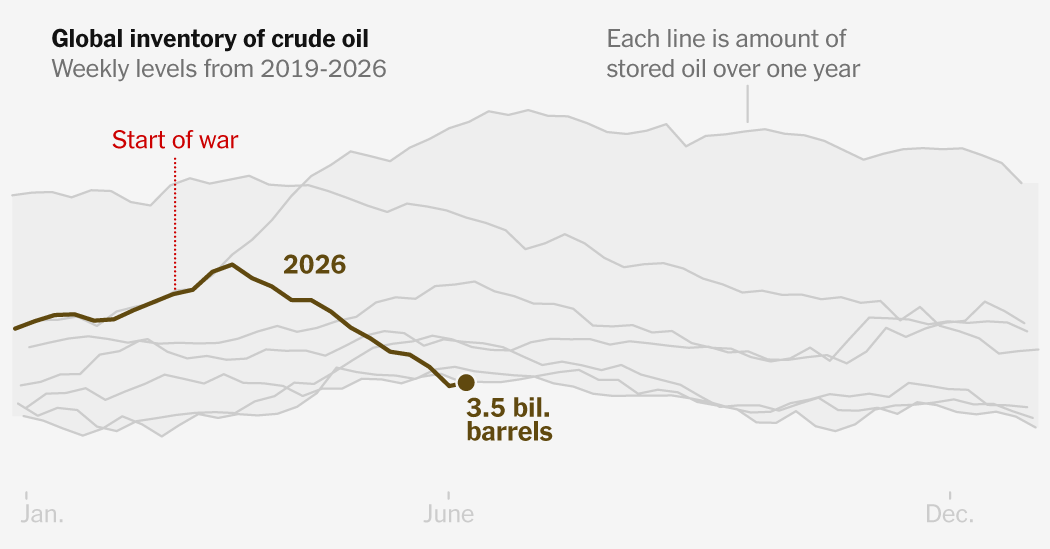
The world is rapidly depleting its oil reserves, putting increased pressure on President Trump to strike a deal with Iran that would quickly get more fuel out of the Persian Gulf.
Vast stocks of oil, gasoline and other fuels have helped fill the global energy supply gap created by the U.S.-Israeli war with Iran. But these reserves, which companies and governments store in huge steel storage tanks and underground salt caverns, are running out in places. This week, U.S. government inventories were on track to hit their lowest level since 1983.
The worrying step was overshadowed by Mr. Trump’s announcement on Thursday that the United States and Iran were close to reaching a peace deal. His statements caused international oil prices to fall below $90 per barrel, well above pre-war prices but far from the highs reached earlier in the war.
Yet the consequences of a truce are far from clear. Unless the supply of oil and fuels improves – and quickly – consumers around the world could face much higher energy costs.
There is little consensus on when or where this might peak, but energy experts largely agree that until more oil can flow through the Strait of Hormuz, the narrow waterway off Iran’s southern coast, the market will remain extremely fragile.
“Soon we will run out of shock absorbers,” said Antoine Halff, co-founder of research firm Kayrros and former chief oil analyst at the International Energy Agency.
The world uses around 100 million barrels of oil every day. Reserves have fallen particularly quickly in countries that rely heavily on imports, such as Japan and South Korea. The United States, the world’s top oil producer, is also emptying its tanks as companies increase exports to supply the rest of the world.
The Persian Gulf countries, on the other hand, have built up stocks, and this is not by choice. The closure of the strait means that most of them can sell much less oil than usual and are therefore stuck with much more fuel. Some have managed to get more ships through the strait in recent weeks, bringing some relief.
And then there is China. The country has what is widely considered the world’s largest oil reserves — about a third of all known reserves, according to research firm Kpler — and appears to have barely touched it. It is possible, Mr. Halff said, that China is exploiting underground reserves that are more difficult to monitor.
“China is one of the biggest question marks, one of the biggest puzzles,” Mr. Halff said.
The picture becomes more troubling when looking at stocks of specific fuels. Reserves of gasoline and fuel oil, used for heating, are particularly low around the world, especially at this time of year.
Yet the world is not yet facing widespread shortages.
“We have less oil in the world, and it’s starting to show up around corners here to show up in end-use markets,” said Rick Joswick, an oil analyst for S&P Global Energy. “But there’s no smoking gun that I can point to and say, ‘Aha, these airports aren’t getting their jet fuel, or these consumers can’t get their gasoline.'”
In countries like the United States, pump prices would likely rise well before fuel tanks run out, analysts say. Coastal regions like the Northeast and California, which rely largely on imported oil and gasoline, are particularly vulnerable to rising prices.
Still, it is very difficult to predict when and where fuel supplies might drop enough for this to happen.
“There are different choke points, and it’s very difficult to determine which one might appear first,” said Daniel Sternoff, a senior fellow at Columbia University’s Center on Global Energy Policy.
To understand why, just look at jet fuel. At the start of the war, many analysts and executives feared that some European airports, which buy a lot of jet fuel from the Persian Gulf, would not have enough to allow planes to take off. Refining companies, which turn oil into fuels, have responded to high prices by increasing jet fuel production while producing less gasoline.
U.S. oil reserves are owned by corporations or the government. Government reserves, known as the Strategic Petroleum Reserve, or SPR, are essentially a last line of defense, available in case of emergency.
The United States is halfway through a withdrawal of 172 million barrels, one of the largest ever. That will leave the reserve, a collection of salt caverns in Texas and Louisiana, emptier than it has been in nearly half a century, shortly after the 1970s oil crisis, when it was first filled.
There is still plenty of corporate-owned oil available in the United States and elsewhere. But the depletion of the SPR will leave the federal government with less flexibility to support the market if the United States and Iran fail to reach a deal or if shipping remains limited.


