
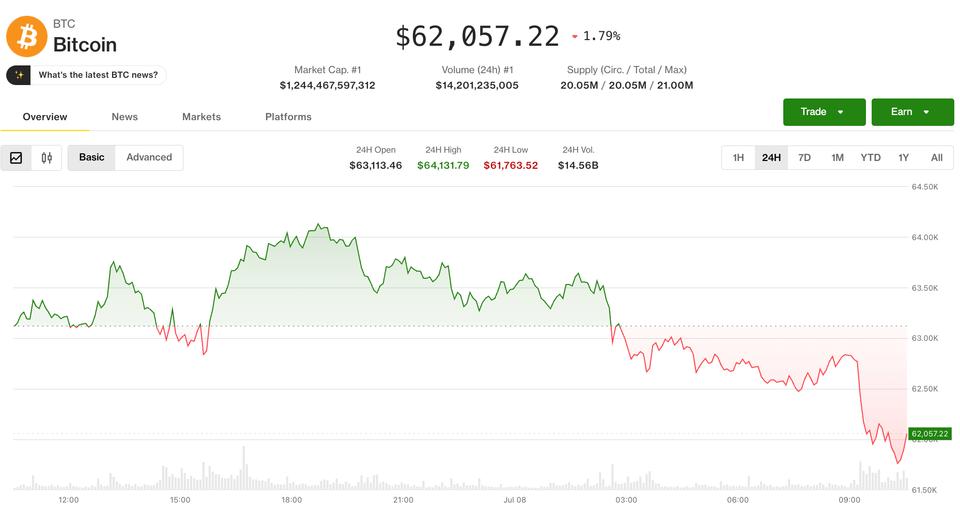
Crypto markets fell on Wednesday after new airstrikes in Iran sparked risk aversion among investors. The CoinDesk 20 Index has fallen 2.9% since midnight UTC, with all but one coin falling.
Speaking to NATO leaders, US President Donald Trump said the ceasefire was “over” and that negotiations with Iran were a “waste of time”, even if talks continue, according to media reports.
U.S. Central Command said it struck more than 60 small Islamic Revolutionary Guard Corps boats to prevent them from disrupting international shipping, and Iran retaliated by attacking Kuwait and Bahrain.
The Dollar Index (DXY) rose as resurgent tensions are likely to fuel inflationary concerns. Bitcoin and ether (ETH), the two largest cryptocurrencies, fell more than 2%.
There were larger losses in the more illiquid altcoin sector, with JUP, ETHFI and PUMP all losing more than 5%.
US stocks were also affected. Nasdaq 100 and S&P 500 index futures fell 1.5%.
Positioning of derivative products
- Despite Bitcoin falling to $62,000, it is still up 6% this month and there is some good news on the derivatives front: traders don’t appear to be shorting the rally. Open interest (OI) on futures fell to 730,000 BTC from over 740,000 BTC a day ago.
- Ether is not doing very well. Open interest remained stable at around 13.95 million tokens despite the drop in spot price triggering bet liquidations worth $90 million. BTC liquidations over 24 hours total just over $100 million.
- Canton Network’s CC token sell-off has accelerated, with the token’s price falling to its lowest level since January, even as futures open interest hits a two-week high. This combination suggests the possibility for traders to short-circuit the decline, especially as funding rates remain deeply negative, near -20%.
- Generally speaking, the bearish grip has tightened on major cryptocurrencies, including BTC and ETH, as indicated by their negative OI-adjusted 24-hour cumulative volume delta. A negative reading indicates that price action is driven by traders placing market orders rather than passive limit orders.
- The latest decline in BTC and ETH appears to have boosted hedging demand for options, as their respective 30-day implied volatility indexes, BVIV and EVIV, are up for the second day in a row.
- The options bias on Deribit confirms this. One-week skew jumped to nearly 20% in favor of puts, up from 16% a day ago. Puts provide protection against a decline in the price of the underlying asset, in this case, BTC. The same goes for ether.
- However, the 24-hour volume figures show the highest activity for BTC call options at the $80,000 strike price.
Symbolic discussion
- The altcoin market is booming, with $350 million of the $450 million in liquidations attributed to altcoin trading pairs, according to CoinGlass.
- Solana (SOL) has now completely retraced a rally that began on July 2, trading at $77 after challenging $84 on Monday.
- MORPHO is a symbol that counters bearish sentiment. The DeFi token is up 4% since midnight as the total value locked (TVL) on the protocol hit an all-time high of 4 million ETH this week, according to DefiLlama.
- A glimmer of hope for the altcoin market is that several tokens are now diving back into “oversold” territory, with the average relative strength index (RSI) falling to 40/100 from 47/100 on Tuesday.


